Angry, Disillusioned and Losing hope!

(AN OPEN LETTER TO THE HON’BLE MINISTER OF RAILWAYS)

Dear Shri Piyush Goyal,

It pains me to pen down this letter, which celebrates the first nail in your new coffin.

Did we hear of corruption scandals when,

  • Delhi Metro gets delivered – stretch after stretch,
  • Sardar Patel Statue was commissioned
  • Delhi Meerut expressway was commissioned
  • Ujjwala Scheme, Skill India, Ayushman, the list goes on and on……..

NO, but when Train 18 is made, we have the news “Train 18 under vigilance scanner”[1]. No amount of course correction by you will now make similar headlines! The damage has been done. The original team who made it has been systematically dispersed, as if the railway system always knew what to do! It never knew and still does not. There is no road map for scaling it up! I hear of a plan on paper, but there is nothing to back up the plan.

As an insider, I vouch that the problem with railway management is not financial corruption, but moral corruption, which the public oversight mechanisms (vigilance, audit, RTI, courts, CBI) have no way of dealing with.

The railway bureaucracy has taken down many well-intentioned Ministers (i.e., Lal Bahadur Shastri, Nitish, Dinesh Trivedi, Suresh Prabhu), and you are next. The only ones who left a mark were Lalu Prasad or Mamta, who never relied on the railway bureaucracy. The ones with whom you deal with today were the cream which was skinned off well before the Civil Services established its sample space for selection. What they are capable of is well recorded in ‘Yes Minister’, and this need not be repeated.

Coming back to Train 18. This is just a Rs 100 crore project. How much corruption could it involve… 50%, 20%, 10%, 0%! Let us calculate the figures and quantify the loss to the national exchequer! On the other hand, what did the phenomenon of Train 18 achieve, or was capable of achieving! Please take your pick and do a cost-benefit analysis (financial or social).  I am sure we would not be able to come up with different answers, no matter how hard one tries. With the files now in the possession of vigilance, I wonder how many excuses have been created once again for the railway bureaucracy not to deliver.

Why am I concerned! At least 200-300 senior public officials pass through my classes every year for discussions on Public Procurement and Contract Management. And they have some very similar question – Why are Railways not showing signs of progress? When will we have a High-Speed Train? When will it comparable to Chinese railways? When will we have Airport like Railway stations?  What did Lalu do differently that there was a turnaround? I kept telling them to work hard working, capable, and honest individuals, who should manage exercising discretion (you are trusted servant of the government) and take fast decisions (which firmly capture your view). An honest decision never got punished, and the like. But after today, I would have to moderate my pitch and argue — better safe than sorry; a ship in the harbor never sank; look honest whether you are honest or not; “Chalta Hai” and the like.

The thought keeps coming back to me – “Albert Pinto ko gussa kyon ata hai! Nahi ana Chaiya!” I see Kejriwal thinking being celebrated, rather than Modi’s or Gadhkari’s.

With kind regards,

Swapnil Garg, Ex Railway Officer

A rat who abandoned the sinking Ship (before it was too late)

Associate Professor (Strategic Management)

IIM, Indore

[1] https://timesofindia.indiatimes.com/city/chennai/train-18-under-vigilance-scanner-files-taken-away/articleshow/69591998.cms

WCTRS 2019

World Conference on Transport Research’ 2019.

  • One of the biggest conferences in the transportation area.
  • Held once in three years and hosted for the first time in India at IIT, Bombay.
  • Registration of over a 1000 delegates, 65% international.
I presented two research papers, which had gone through the review process of the conference. The papers find a way into the journal “Transport Proceedia”.
I also hosted a Special Session. It had Prof. G Raghuram (IIM, Bangalore) and Prof. Thillai Raja (IIM, Madras) as the speakers, besides me. This session was conducted as part of the PPPINDIANET (a virtual network of PPP researchers in the country), which I am coordinating. During the session, we launched a database (developed by a private firm in collaboration with IIT, Madras). This found mention in the “The Hindu Business Line — Online edition”.

Is the commercialization of a public engineering organization complete?

This a heartfelt appeal to the Indian Railway’s top management to wake up and prevent the complete commercialization of a public engineering organization that is the lifeline of the nation.

The latest railway accident of Utkal express (19th August 2017), resulting in death of 23 and removal of ME, GM, DRM, CTE,  Sr.DEN etc. is a glaring example of what has gone wrong with the Indian Railways over time. Such accidents, which are primarily designed by humans by commission or omission, hurt deeply. Ironically, once again, there are no signs of addressing the core issues, but rather at dousing the fire, and killing the symptoms, rather than the disease.

One just need to talk to one of the 13,00,000 + railway employees and arrive at a list of ills in the organization. Thse range for erosion of dedication and sincerity, poor recruitment policies, over staffing, over-emphasis on passenger amenities at the cost of safety items, etc. The list is endless and everyone has his own unique understanding of the problem. But, is this not common in the case of any organization? What gets consistently missed in this long list is the recognition that a primarily engineering organization is getting progressively commercialized! The people at site have been punished, and accountability fixed to the highest levels in the organization. This is like any commercially run professional organization, and the mission seems to have been accomplished in making railway staff responsible for their actions. But this leaves one wondering — will these actions prevent the second accident of Utkal Express at the same place?

Some facts. Trains run on steel rails, and the steel rails have to be continuous. One of these rails developed a crack which was detected at noon (12:00 hrs). Till 17:46 (more than 5 hours later) when UTKAL express ran off the rails at this point, the tracks had not been closed down for repairs. It was being debated upon between operating managers and their engineering counterparts—should we close the track or not! No one realized that if there is no track, there are no trains to be run.

The response! On well recognizes that accidents of this magnitude do not happen by the fault of one! Firstly, those who faltered in fixing the track have been taken up. They should be. Everyone in the hierarchy – ranging from all those at site to the one in the Board should be sacked summarily, as they failed to recognize the importance of their work. They had completely missed the fact they are playing with the lives of public, and their jobs are a small part of it. I fully stand by the sacking of PWI to the Sr.DEN! Knowing the guts of system, I can draft their list offences in exact detail identifying how they contributed directly to the accident. Each of them were aware of the incident in realtime, but played it safe personally – to make railways unsafe for the public. Why was the rail cut without the block, and why was the banner flag not put up, are some of the failures for which they are directly responsible. This makes the people responsible for maintaining the track responsible.

Secondly, and more important—- who made them do that! For this, the removal of the DRM, CTE, GM to the ME becomes justifiable. They did not know of the incident in real time, but by their repeated actions and inactions they were responsible for the actions of their men!

However, we have all been silent about one part! What about the traffic department (operations the holy cow) who have refused to allow time for maintenance, or the engineering departments heads who could not put enough courage in their men to stop a train from running on a broken track! A key and important part here has been played by traffic department, which has cleverly become a hero here (while being the key instigator behind the crime). The full brass of operating people needs to be taken up similar to engineering and fixed. That is, those involved with the incident in realtime (section controller, Chief controller, DOM) and those behind the scene who had given the courage to behave the way that they did (which includes the CFTM/CPTM/COM the Operating equivalent of CTE, and the Operating equivalent of ME at the board level i.e., MT).

To make the role of operating more obvious one needs to know that the allotment of time for maintenance is an age-old problem in railway working. It is a tussle between the engineering and the operations since the railways started operating. One of the primary agendas for cross functional incharges (the DRMs and GMs) has traditionally been to maintain this delicate balance. Time had to be allowed for maintenance, at the cost of punctuality and moving higher traffic! And, there were times when this was fought tooth and nail, when people believed in the importance of their work. In the Indian Railways, the key problem has always been that while railways is a complex engineering institution, ironically in our case it is run by social science professionals. With time, the engineering has become secondary to operating/commercial interests, and result is obvious in this accident.

My prior experience with railways makes me fear that engineering will once be punished, while the operating will once again go scott free, making the organizations transition from the engineering to commercialization complete. This is not the last Utkal express accidents, but only one of the many which keep happening increasingly in the railway system, while it looses its engineering sheen!

ONE OF THOSE ROUTINE RAILWAY JOURNEYS!

Now,I travel far less by train compared to what I have done during most of my railway life. These are some observation during one such train journey in August 2017, and written while on the train. Railways is a huge system, with a very capable set of people, but it has been delivering far less than what it is capable of. In this piece, I identify two reasons which could lie behind this.
 The railway system fails to systematically learn from failures.
o The system is too busy hiding, defending, and negotiating failures, that there is little energy left for systematically learning from failures.
 There are far too many ears and eyes inspecting, compared to the minds and hands at work.
Below I attempt to qualify each of these conjectures with some examples.
LEARNING FROM FAILURES
As I look outside the train window, I see multiple rakes of covered goods wagons roll by. These were the BCNA wagons that had given me many restless nights during my railway days. The conventional covered wagon had been redesigned in 1990’s to increase its loading capacity. This also led to its doors getting modified for easy loading and unloading. Launched and celebrated as a great innovation it soon emerged that during train running the doors would open out, and break signals and other fixed structures. This became an operational nightmare, with trains behaving as torpedos. After numerous attempts of hiding, defending, and negotiating, the failure was recognized and it was decided that the doors would be redesigned for new wagons, and also modified in existing wagons. Wagons were called back and refitted with modified doors. A huge failure, which would have cost railways crores of rupees.
Firstly, is there an estimate of what the mistake costed railways! While we do have guess estimates of what the challenger crash costed, or what the titanic sinking costed, but we have never cared to estimate the cost of this failure. If you don’t measure it, you are unlikely to address it. Secondly, mistakes happen, and when one attempts new ideas they happen more often. But, these mistakes are supposed to pave the steps to success. I wonder, what the railway management’s take away was from this failure, other than ensure that changes to proven design not be made. Thirdly, was this a one-off failure? We would never know! We never got it studied and never got it documented.
Sitting in one of the most modern coaches over the railway system, every ten minutes I am subjected to a longitudinal jerk. This jerk, a decade after the introduction of LHB coaches, is enough evidence that little learning has happened from failures! This problem is known to railway managers from the first time that they ran trials on LHB rakes, and it still exists a decade later! There are many more such failures – rail fractures, OHE snapping, etc. which I can name. And, many more of those which go unnamed in the railways failure investigation, getting attributed to law order or cow runover! For instance, buckling of track in extreme winter, to which we never even attempted to find solutions to!
It would not be out of place to argue that the significant improvements in railways overtime are largely technology driven, and not because of learnings from failures. Most of the things within the direct sphere of influence of railway managers have remained the same, with little visible improvements on their own (for instance poor quality in purchase). Even office cleanliness and efficiency in procurement had to be externally driven by the prime minister and technology respectively.
INSPECTING AND WORKING
I remember a time during one of my early postings. I got so hassled inspecting the same problems again and again, that I resolved not to visit a depot unless I had addressed all the previous observations that had been made, or had made some progress worth reporting. However, the inspection quotas ensured that I was back inspecting the same depot again, noting down the same action points once again. The system so routinely inspects, that it forgets what it is inspecting! Please see the photograph of electrical panels below! The covers of electrical panels have been opening and hanging for over 3 decades now, and it is the same problem (may be varying in degree) whether it be general second, or Rajdhani/ Shatabdi! Railways is a very democratic organization. This problem is the attributed cause of serious fires in general second coaches, and a regular eye sore in higher class coaches. Only today I saw a video of an air plane crash being attributed to a knob being left in the wrong position after maintenance, losing over a 100 lives.

Railway Switch board.jpg

Have no inspecting officers noticed it in all their train journeys? If we can’t lock the covers and keep them in their place, let us not have them! They are already missing in 50% of the places, let them not be fitted in the first place.
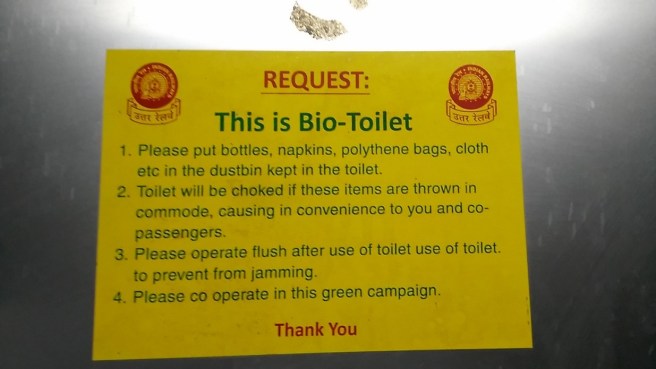
Another classic example is the innocuous notice below.

Railway Biotoilet notice

I have been training my pre-teens to keep themselves occupied in restaurants (while waiting for food) by looking for spelling mistakes in the menu card! It is an entertaining exercise, but with word having inherent spell check fewer and fewer mistakes are found. The notice above would have provided them with a gala time. It is a public notice that no one cared to proof read before printing! Further, while railways would have spent a significant amount of money printing them and pasting them, no one cared to ensure that they be pasted straight. Also noticed the half peeled seat numbering stickers—the once that were recently pasted with brail lettering! Is there one thing that we can do properly! May be yes! 5 years later I saw most door closures working, and having date of fitment over two years back. But someone would have to verify this if it is true.
However, these are tell-tale signs to the bigger problem. They have been addressed in the inspecting culture by having more inspections! But would that solve the issue! Would the door closure issue be fixed by the inspections? It got resolved (if it did) when the Railway Board changed specifications and ensured their quality! A job that according to me was not its responsibility.
Again, these are not isolated cases. How have the ills of collie overcharging, broken platform floors, broken lights, dirty linen, broken road surfaces at railway crossing escaped the attention of the regularly inspecting officials! Actually, they have not missed the attention of these officials, they have simply been ignored! We need more of the hands at work, rather than the eyes and ears inspecting finding faults and ignoring them.
And above all, it will definitely help if we can have some minds at work too!
Epilogue:
Opening the newspaper today and reading about a railway accident reconfirms the second point about inspections that I made above. Utkal Express derails near Khatauli, killing 30, when the site of accident is being inspected by a senior officer. Do not jump to conclusions, as circumstantial evidence and piecing together evidence is not enough. How can a senior civil engineer inspecting at a site under maintenance cause an accident? Pun intended! In my 23 years of railway experience, this was an ideal setup for one to find broken brake blocks, wagon parts, or even any other rolling stock component on track. And, suddenly there is an alternate story of how the train suddenly jumped because of a previous train’s component on track. I await one!

What do government officers do?

I have spent the last 5 days reading about the life experiences of Jagdish Khattar (An ex IAS, MD of Maruti Udyog 2000-2007), visited two government offices (NHAI and Railway Board) and a Visa processing center. Four very different government run organizations — with key differences lying in full/partial governmnet ownership, Indian/UK, policy/operational, service/manufacturing — but also similar. All of them existing to do essential public servcie jobs, and with their tasks being of regular and routine nature. What struck me was the deep entrenchment into routine working and it being THE JOB (NHAI and RB) as against outsourcing it or breaking it up (Maruti or UK VISA). People in NHAI and RB were busy with routines, and this has become their life and job.

This also reminds me of a remark in Mr. Ashwani Lohani’s ten year old book — “ Remaining busy is considered synonymous to deliverance. How busy an individual is has become an established norm for judging the operational efficiency of the person” Pg 6 Ch 1 and later what follows is a “A perpetual frown on the face that conveys the impression of carrying the trouble’s of the world on one’s head” Pg 7, ch 1. The Sarkari way of working!

I am uncomfortable with this, and the perpetuality of this routine working! The troubling questions — first and foremost– Is there anything wrong with this sarkari way of working! If not, we are fine and let us carryy on as is. If it worries us, the existing options lie in outsourcing (UK Visa) or in change in ownership (Maruti)! The second question – are these THE options or we can think of alternatives beyond them. The third question — How long will the bureaucracy take to think of the alternatives! Will the other stakeholders hold their patience for all this time? How long before they start exploring the existing available options.

The looming threat! Maruti negotiated when it found that the only option for it lay in replacing the routine manual material movements with conveyors and robots, quite in contrast with they had thought of 2 decades back. UK Visa office cut the work out from their embassy and handed it over to low paid Indians. We continue to tell our students — recognize that the nature of work is changing and is changing fast! When will the sarkar recognize the need to shed the routine working and hand it over to their own or external systems. Devote the highly intelligent resources that they possess to more value adding roles!

Paper Published in FT50 Journal

Have managed to get published in one of the top journals in the management field — Journal of Business Ethics (list maintained by Financial Times https://www.ft.com/content/3405a512-5cbb-11e1-8f1f-00144feabdc0).

Neither is business ethics my core focus, nor is development of pedagogical tools my expertise area. However, both the areas are closely intertwined with what a business management educator does. Hence, I am proud (and extremely proud) of the publication ” Integrated Live Case: A Contemporary approach of Business Ethics Pedagogy.”
Can be accessed online form the link here, or write to me to get a copy.
( https://link.springer.com/article/10.1007/s10551-017-3514-6?wt_mc=Internal.Event.1.SEM.ArticleAuthorOnlineFirst )

What we do here is quite comprehensive and interesting! We survey business ethics pedagogy literature to identify what they have to say about teaching business ethics (408 papers reviewed). With this we develop a framework that we call the “ACD framework” (Approach, Content, and Delivery). This comprehensively identifies the different aspects of business ethics pedagogy, in the form of six binaries — two in each of the ACD elements — Approach (Theory or Realworld Connectedness), Content (Depth or Breadth), and Delivery (Traditional or Innovative). Moving further, we provide and propose a new business ethics pedagogy — Integrative Live Case(ILC) — as a generic way to address the different needs of the ethics pedagogy. To make our case stronger, we provide a instantiation of our proposal, providing a detailed template of how to use ILC to address the needs of a good business ethics pedagogy.

Writing this paper has been a great and highly fulfilling learning exercise in team working, idea generation, and academic writing. Our team (3 of us) may have easily spent more than 150 hours each on this project in team meetings, and a similar amount in individually doing our work. With the mission accomplished, the whole time spent in worthwhile both as a result, and also in what it has left behind with us. We can think a little more clearer, and also a write a little better, without a doubt.

I write this giving myself a pat on the back, and moving forward! Amen.

Fixing Indian PPPs: Limit on private sector opportunism

First it was the road to Gurgaon (NH-8) and now it is the road to Noida (DND Flyway)! The early PPP projects in the country seem to be falling apart like a pack of cards, but only after an ugly public spat. In both these projects, the public played a major role in demolishing them. In the NH-8 case, it was public outrage against the traffic jams at the toll booth on Delhi Gurgaon border that eventually compelled the government to force an out of court settlement among the stakeholders. In the case of the DND Flyway, the public directly took up toll collection issues with court, and won court room battles in both the High Court and the Supreme Court. The paradox lies in our attempts to raise the countries ranking on the index of doing business in India[1], while we work around contracts or set them aside through courts.

However, these two projects do not represent the transport PPP projects in the country. Both these projects had been conceived in the early stages of the countries PPP journey, they had experienced good demand, and have practically no monopoly rights. As early stage projects they had faulty conceptualization. In the case of NH-8 the fault lay in the assumption that we could operate an access controlled road within city limits, while in the case of DND Flyway it was the contractual promise for 20% return on project cost (and not on the equity invested). Since then transport planning and contractual clauses have evolved significantly, addressing these conceptual errors. NH-8 had faced good traffic demand from the first day due to the boom in Gurgaon, whereas DND was slow to pick-up but finally it did could attract good traffic. This is in sharp contrast to most other road projects in the country which suffer because of optimism bias in traffic estimates. Both roads have numerous alternatives such that monopoly returns are not possible, unlike most highways which are the only ones connecting two cities. In retrospect those fighting for removal of the toll plazas claim that these projects should have been done by the government itself in the first place, leaves one to wonder where would the Indian PPP journey stand today had this been the case! We need recognize that these projects helped us learn a lot, and learning happens at a cost!

Beyond the obvious contextual similarities, the projects are also similar in two additional assumptions regarding the role of the public and the private agencies in a PPP.  The first being an assumption about foresightedness of the government, and it quick decisions, none of which ever happens in real-life. Understandably, this also does not raise eyebrows, as it is expected that the government would falter on these aspects. However, our core argument here focuses on the other assumption — opportunistic behaviour by the private sector. Once again, this should not raise any eyebrows as private sector is expected to act in an opportunistic fashion. This is where our argument differs. PPPs are different! Different in regards to the public service that they involve and the public asset that they create. However, we are seldom able to fully comprehend what this entails.

PPPs are not operated in a free market. Here the risks and rewards do not solely lie with the private sector to enjoy and suffer! PPPs are about optimal risk sharing. Businesses do not take up all the risks, the evidence of which lies in the numerous appeals by the industry for loan refinances, bank guarantees, deferments of loans, single window clearances, allowances for non-performing assets, new PPP models and the like, all aimed at forcing the government to bail out bad business decisions. But, when it comes to rewards, the private sector closes its doors—this is my money and I am free to pocket it, and this is as per the contract.

This is what had happened in these two cases. The concessionaire capitalized all future toll revenues in the NH-8 project and picked up a loan of Rs 1600 cr, but made no sincere efforts to address the toll booth traffic jams or maintain the expressway. The same happened, when NTBCL (the concessionaire for DND Flyway) kept adding its 20% assured return to bargain for extended life for the project and giving veiled threat for staking its claim for the land that it had been promised as part of the contract, but not yet been handed over. In the case of NH-8, the industry further repeatedly warned the government not to attempt a project takeover, as it would disrupt the investment sentiment of the country. Every trick in the book was tried to ensure that every paisa that one is entitled to as per the contract, is pocketed!

As the conceptual motivation behind PPP projects lies in leveraging private sector efficiencies, hence wringing the inflows to extract the last drop should be acceptable. However, what remains unclear is the extent to which one can behave opportunistically, while working in a public service context! An example of a hospital project in UK comes to my mind i.e., Norfolk & Norwich University Hospital that opened as a PPP in 2001. Like NH-8 and DND Flyway projects, which were one of the first in the Indian transport sector, it was also one of the first sizeable PPP deals in the UK health sector. The government, which was very keen to attract the private sector for infrastructure investments, bent over backwards to get the private sector to commit in the project and gave it a very favourable deal. The concessionaire within two years of running the hospital got a cheaper mortgage and made a gain of  £116 million. The shareholders of the concessionaire were pressurized to contribute to the hospital out of this abnormal gain, but the only one to respond to this call was a maintenance and catering staff of the hospital who held a small number of shares in the concessionaire’s parent company. Finally, the concessionaire did handover £34 million to the hospital trust, though it was not required to make any such payments contractually. The concessionaires recognized the limit of opportunism that they could get away with!

PPPs are not Apple! When the project fails, private sector is not the only loser. The externalities associated with the project rope in the public and force it to bear a part of the loss directly or indirectly. So, when projects succeed, why is the public not pulled in to be a part of the gains.

While, the argument about private sector’s accountability and responsibility to the public in general may be convincing to some, other do not buy it! For them a contract is a contract. Why should the private sector pay, if it is not required to. However, firstly they fail to recognize that the public context has its nuances. It needs to be given its due for the unique contributions that it brings in. For those uninitiated, these lie in easy policy frameworks, interest free loans, investment tax holidays etc. initially or bail outs, waivers of loans, accountal of non-performing assets, debt refinancing etc., when disaster strikes! Secondly, business management repeatedly argues for stakeholder management and underscores the need for stakeholder involvement and satisfaction. Hence, even if one views the contract as being sacrosanct, and would only like to work within its framework, one cannot avoid stakeholder management, and specially while working with the public sector.

Hence, there is a limit to private sector opportunism when it takes up work in public sector. Specially, in the PPP context the risk allocations and attributions through expected to be optimal, they are unlikely to be so. Sharing risks, one may need to come to the aid of the other and accommodate one another. While contracts would remain sacrosanct and need to be rigidly adhered to, if one does not indulge in adequate stakeholder management (and here one does not refer to bribing) one should be prepared to be manhandled: set aside by the courts in public interest, or forced into out of court settlements.  This is also a warning sign for all those who bank on the helping hand of the government! The government hand of support comes with a lot of written and unwritten agendas, and one should be ready to service these agendas before one decides to take this helping hand!

[1] One of the doing business aspects is “Enforcing contracts”, where India ranks 178/190.

Fixing Indian PPPs: Questioning the proposed options!

Fixing Indian PPPs: Questioning the proposed options!

Yesterday, my brother shared an article with me wherein my favorite subject of PPPs (Public-private Partnerships in infrastructure) was addressed. [1] The article discussed ways to fix the flawed PPP model by converting them into FPTP (First Public, Then Private), as proposed by Mr. Subir Gokarn ( a front-runner for the post of RBI Governor). This catches my attention as this is not the first time that PPPs in India have been discussed with acronyms. The Economist in 2012 labelled Indian PPPs as RIPPP [3], Mr. Shailesh Pathak (with impressive governments and private sector credentials) has called them TTT (Taxpayer to Tycoon Transfer) [2] and Mr. Laloo Prasad Yadav, in his extreme wisdom has wondered during a press interaction, “What are these Ppeeeeees (pun intended)”!

The common thread running through these discourses is that something is fundamentally amiss with PPPs in India, and something need be done. Both, the FPTP concept and Mr. Shailesh Pathak’s recommendations argue that PPPs need be reconfigured, and broken up. The atypical Indian conditions require that the government build an infrastructure and then ask for a private partner to come in to operate it and service it through user service charges. It is argued that this would resolve many of the issues that Indian PPPs face. While, I share their concerns about Indian PPPs fully, I only agree partly with their proposed solution. That is, I also see problems of PPPs lying in bundling, and see a solution in unbundling PPPs. However, while my arguments are theoretically motivated, they specifically argue for unbundling of a different kind. I recently presented a paper on this at the World Conference on Transport Infrastructure and it would soon be published as part of their proceedings.[4] The sketch of my argument as given below, with my primary difference of opinion with the experts views highlighted.

Let me start from the beginning!

The theoretical drivers for PPP have been intensely debated in the literature. When one claims that PPPs are easy source of money for the government, the argument falls flat when one recognizes that the government has access to the cheapest debt credit. When one argues for private sector efficiencies, one soon realizes that these can be better purchased in arms-length contracts. The PPP rationale lying in practices driven rationale like possibility of off balance sheet financing by the government, or political inclinations to ribbon cutting, are short-lived in nature as audits and public soon see through them and they lose their sheen. What however stands ground is the inherent value creation driven by the innovations which happen when the construction and operational phases get combined together.

Coming from the management field, I argue that bundling increases complexity and one of the most recognized ways of negotiating complexity is by bringing about modularization, which involves unbundling. One can see evidence of this all around. Let it be products (computers, cars, space-crafts etc) or processes (programming languages like C, sophisticated process controls, etc). It appears that no matter how complex a thing, we can build it using independent and self-sufficient building blocks. It is all like LEGO! However, there is a difference…..

As our needs grow, things become more and more complex as we start bundling features together.  To address the complexity, we have to necessarily unbundle, however when one starts to unbundle one no longer unbundles along the same axis, or along the same lines along which bundling had been done. For an example, just look at the phone in your hand! Our phone is a bundle of voice recorder, watch, camera, phone, video recorder and blah blah blah. But when the ensuing complexity of the phone is unbundled by its designers, it is unbundled as hardware (with mic, camera lens, speaker, keyboard, screen etc), operating systems, and applications (our apps). The complexity of the phone is not unbundled by separating out the camera, video recorder, voice recorder, and the phone, and just putting them together in one place! And, as I see it the meteoric rise in the value of a mobile phone as come from this simultaneous bundling and unbundling, but along orthogonal axis.

Then why are our PPP experts recommending unbundling along the same axis along which value creation was initially argued for!

For me, PPPs are bundles of construction and operation phases, and it is this bundle which can potentially drive value creation. This bundle becomes complex due to the myriad of activities and people involved. It is required to be unbundled, but not into construction and operation phases. We have to search out alternate ways of unbundling PPPs, and along orthogonal axis. And, your suggestions of what these could be are as good as mine! These would be highly contextually driven, and one would be required to search out the best such axis in each case!

What happens if one follows the advice of our PPP experts and unbundles along construction and operational aspects? Some preliminary observations…. The first thing we would sacrifice would be value creation through innovation. While describing the atypical Indian system, one finds abundant evidence of non-professional government, lack of government’s technical competency, inflexibility in working, risk averse nature etc. (I would argue that these are not atypical of India but typical of the public systems world over). If this is the case, then putting the onus of designing detailed specifications for infrastructure which is to last for 25-50 years, and executing the work though the L-1 contracting within time and cost, does not seem to be a possible alternative within the government systems. Further, what would happen when we transfer a government asset to a private contractor for the operational stage? The same thing which happens in every college food mess through-out the country or even in government housekeeping contracts! The lowest bidding service contractor steps in, makes all possible shortcuts, hires underage boys, runs them 12 hour shifts, uses substandard material, and when you question him….he cites the abysmally low rate that he quoted as an excuse! Despite our best efforts, uncover the shades and you would find this rampant all around, and right under your nose.

Ironically, the PPP regime had aimed for growing contractors into concessionaires, but the proposed unbundling aims to reduce the erstwhile contractors into small time government general order suppliers! One just wonders — do we want to get into this situation!

Hence, fundamentally splitting or unbundling along the operations and construction interface is not a viable option, as it is a fundamental innovation driver for the PPP system. The same inefficiencies and immaturity which are today driving our unbundling arguments, would haunt us in the new public constructed and private run setup (FPTP). Splitting or unbundling is necessary, but only to address the increased complexity of the system and not address the deep-rooted ills of our system, which need to be addressed outside the PPP regime. There are no specific recommendations of how it is to be done, as this would depend upon the context one is working in.

REFERENCES:

  1. http://swarajyamag.com/economy/here-is-what-subir-gokarn-suggests-to-fix-the-flawed-ppp-model
  2. http://economictimes.indiatimes.com/news/politics-and-nation/ppps-are-good-in-theory-but-in-india-they-are-a-failure-in-practice-shailesh-pathak-ed-bhartiya-group/articleshow/47940584.cms
  3. http://www.economist.com/news/finance-and-economics/21568397-indias-love-affair-public-private-partnerships-faces-stern-test-rippp
  4. Garg,S & Garg, S (July’ 2016) Rethinking Public-private Partnerships: An unbundling approach. Abstract selected for presentation at the 14th World Conference on Transport Research at Shanghai, China, 10-15th July’ 2016. (Will soon be available online)


NOTE: I have serious concerns with both the data and the views stated in Swarajyamag article, but I purposely decide not to direct this piece at these aberrations. For instance, it talks of 188, and 248 road projects. I have identified 660 PPP road projects in India, and I am studying them. It writes, “The FPTP model aims to achieve the objective of optimal allocation by allocating the risk to the participant who is well-equipped to deal with it in its normal course of business” — this is exactly the same aim and objective by which PPPs had come! So what is different. Mr Gokaran is stated to be talking of FPTP for a couple of years, which is 2 years. Mr. Shailesh Pathaks’s working paper is dated 2012, which is five years back!

 

Lost in The Concrete Jungle

Lost in the concrete jungle… (Reposted from  facebook)

Idea credit –-Saarthak Garg
Written by –- Swapnil Garg

Recently, I visited Shanghai with my family. I was to attend an infrastructure conference on transport policy (the World Conference on Transport Research). As is usual with my visits to conferences with my family, I spend a considerable amount of time at the conference, till the time of my own presentation. After this my attention wavers off and I only attend select sessions which are of importance to me and which are directly related to my subject of interest. Hence, my family gets a significant amount of time early on to see the place on their own, and then I join in. During this visit, my two sons were 11 and 9 years of age, and studying in classes six and four respectively. As this was school session time in India, we had sought special leave from their school for them with an assurance they would collect data, information and facts on China during the visit, and present the same as reflections to their class and to their school.

On the third day, while we were traveling in taxi, my younger son (9 years, Class IV) made an interesting observation. When asked about his reflection on Shanghai and what he would write about it, he remarked, “See there are so many identical twins, and also so many clones. But, I feel sorry about some of the lone ones, and I am sure they must be very lonely”. Wondering what he was referring to I poked him to elaborate. He pointed towards the Shanghai skyline, and asked me to note. Most buildings came in pairs. But, many buildings had multiple replicas of themselves, and many could mean any number like five, ten, or even twenty when we counted. However, there were still many buildings which were one of its kind, standing lonely and all by themselves.

A nine year old, lost in this big concrete jungle, had created life out of inanimate structures and give them a new meaning. From that time onwards, and till the end of our Shanghai trip six days later, we identified thousand of mono-zygotic (similar) and di-zygotic (dis-similar) twins, taller and shorter siblings, armies of clones ready to attack, and we also felt sorry for those lonely individual building which had no company.