Academic resources page for the course, workshop, or individual sessions that I occasionnaly teach. This page also serves a s respository for PPP material that I follow over time, to continue upgrading my knowledge on PPPs.
I have been teaching an elective course on “Managing PPPs” since 2015 at IIM Indore. Every year 2 sections get subscribed. Also, I have been teaching in executive programs and conducting workshops on PPPs, and routinely covering PPP (an introduction) for senior officers of Indian Railways attending various in service trainings at National Academy of Indian Railways, Vadodara.
A draft of the course line that I use .
PPP An Introduction
In one of the first papers I crafted in the PPP context, I sought to deepen my understanding of PPPs. This paper presented at the World Conference of Transport Research, Shanghai, China (2016) has the highest number of citations among my published papers. It is open access and can be assessed from HERE. In this paper, I explore the definitional base of PPP, looking at WHY PPPs? , Issues with PPPs, and the need for rethinking PPPs.
In this section, I take you through the alternate definitions of PPPs, discuss a common definition generic definition to build context, discuss the issues around PPP definitions, and finally arrive at a novel way looking at PPPs, which encompasses most of the generally held views on PPPs.
Definitions
| Definition | Source |
| “A cooperative arrangement between the public and private sectors that involves the sharing of resources, risks, responsibilities, and rewards with others for the achievement of joint objectives” | Kwak,Chich, & Ibbs (2009) |
| PPPs are a tool that help governments leverage the expertise and efficiency of the private sector, raise capital, and spur development. They also help allocate risk across the public and private sectors to where it can best be managed and ensure that resources are wisely distributed in addressing the most urgent development needs. | International Finance Corporation |
| “PPPs are a mechanism for the government to procure and implement public infrastructure and/or services using the resources and expertise of the private sector. Where governments are facing aging or lack of infrastructure and require more efficient services, private sector partnership can help foster new solutions & bring finance.” | World Bank |
| “The relationship formed between private sector and public bodies often with the aim of introducing private sector resources and/or expertise in order to provide and deliver public sector assets and services” | European Investment Bank, 2004 |
| “Involves the private sector in aspects of the provision of infrastructure assets or of renewal of existing infrastructure services that have traditionally been provided by the government” | World Bank, PPIAF (2014) |
| “PPPs are a contract between a public sector authority and a private party, in which the private party provides a public service or project and assumes substantial financial, technical, and operational risk in the project.” | National Council for Public-Private Partnerships (NCPPP, USA) |
| “PPPs broadly refer to long-term, contractual partnerships between the public and private sector agencies, specially targeted towards financing, designing, implementing and operating infrastructure facilities and services that are traditionally provided by the public sector.” https://www.adb.org/sites/default/files/institutional-document/31484/public-private-partnership.pdf | Asian Development Bank (ADB) |
| “A PPP is a long-term contractual arrangement between a public party (such as a government agency) and a private party (such as a private sector company) for the provision of public assets and/or services, through investments being made and/or management responsibility being assumed by the private party.” | United Nations Economic Commission for Europe (UNECE) |
| “Public Private Partnership or “PPP” is a form of fixed-term contractual arrangement between a public entity on one side and a private entity on the other, for the provision of public assets and/or public services through investments being made and/or management being undertaken by the private entity, may or may not require payment of fee by users, for a specified period of time, where there is well defined allocation between the private entity and the public entity and the private entity’s performance is contractually obligated to conform (or are benchmarked) to specified and pre- determined performance standards.” | Department of Economic Affairs’,, Government of India |
| “PPP means an arrangement between the central, a statutory entity or any other Government-owned entity, on one side, and a private sector entity, on the other, for the provision of public assets or public services or both, or a combination thereof, through investments being made or management being undertaken by the private sector entity, for a specified period of time, where there is predefined allocation of risk between the private sector and the public entity and the private entity receives performance linked payments based on performance standards.” | Manual for Procurement of Goods, 2017, Department of Expenditure |
| UNCTAD’s working definition covers the following key characteristics of PPPs on which most definitions converge: – Cooperative project between the private and the public sector; – On a long-term basis (can range from a few up to 30 or more years); – For the provision of a public asset and/or public service; – Sharing of risks, responsibilities and rewards between the project partners. https://investmentpolicy.unctad.org/pages/27/what-are-ppps | UNCTAD |
| “The term “PPP” does not denote innovative finance as such, but instead, innovative procurements of major capital projects in which private capital is invested. PPPs may be distinguished from other collaborative arrangements between public and private sectors that are not procurements but instead are mechanisms to provide private capital to transit projects. Many transit agencies, for example, partner with the private sector to promote real estate development in and around transit facilities, which is often referred to as joint development or transit-oriented development. These partnerships provide access to additional capital and operating revenues for transit agencies through the receipt of lease payments, access fees, and increased fare revenues, as well as direct private sector funding of capital facilities that promote access between transit and private development. The capital-raising function, however, is but one element of a PPP..” https://www.transit.dot.gov/funding/funding-finance-resources/private-sector-participation/private-sector-participation-and | Department of Transport, US Government |
PPP LABEL
Besides the ambiguity around a definition of PPP, there is a lot of ambiguity around the label of “PPP” . Also. Below I summarize some of the labels that I have come across during my study of PPPs.
| Source | Label |
| Public Private Partnerships | |
| BOT,DBFOT, DBFO, BOO, TOT, HAM, | |
| UK Government | Private Finance Initiative ( PFI 1, PFI 2) |
| Management Literature | Hybrids; Community Partnerships |
| Davidson (2010) | Private Sector Participation (PSP) |
| Long Term Infrastructure Concessions (LTIC) | |
Definitional Challenge
The PPP concept faces a definitional challenge (Kwak, Chih, & Ibbs, 2009).
There is a “paradox in what PPP really are”, and this has led to the “PPP phenomenon remaining an enigma despite all the PPP talk” (International Handbook of PPPs (Hodge, Greve, & Bowman, 2010))
There is no single internationally accepted definition of PPPs. (World Bank Reference Guide, 2012)
It is not defined at the community level (European Commission, 2004)
Implications of a definitional challenge
As per my argument, the definitional challenge faced by PPPs, manifests into a very large variety in the public-private interactions that get labelled as PPPs, with little consistency and often debates about what is and what is not a PPP?
This logic behind this argument goes as follows. Scanning across the definitions, we find four common elements (these have been made bold in the definitions above (the unique elements in each definition have been italicized). The four common elements do little to reduce ambiguity, as they in themselves are highly ambiguous. I take the definition proposed in a leading management journal (California Management Review – a academic cum practitioner journal). I dwell on each of the aspects below.
Cooperative Arrangement:
Public and Private:
Joint Objective
Sharing of risks, rewards, responsibilities and resources:
PPP Concepts
Some concepts are unique and of prime importance in the PPP context are Public Sector Comparator, Value for Money, and risk allocations. To build an understanding on this I use the Grimsey & Lewis (2002) paper in International Journal of Project Management.
| Grimsey, D., & Lewis, M. K. (2002). Evaluating the risks of public private partnerships for infrastructure projects. International Journal of Project Management, 20(2), 107-118. http://www.sciencedirect.com/science/article/pii/S0263786300000405 Two online videos on Value For Money are also useful resources here. In these two videos, James Ballingal (UK Govt). provides a good conceptual background on value for money, public sector comparator and risk allocations. |
References
PPP Cases
INDIAN CASES
MY CASES
I have been writing and publishing cases on PPP, analyzing and recording the progress of PPPs in the country, primarily from a learning perspective. These cases are mentioned below, and where possible I also provide links to them. For others, you may write to me for copies.
Road Learnings: Rau-Pithampur road project – The first road PPP of India — Published with IIM Indore case center
Coastal Gujarat Power Limited: Private gains, Public losses — Published with Ivey Case Center
Mundra Power plants: Risk and uncertainity management
Garg, S (2020) Adani Power: Risk and Uncertainty. IIM Indore Case Center. IIMI/Case/2020-4
Ghatak, A. R. & Dasgupta, A. (2017). Raising the ‘Bar’ for India’s Power Sector. Insight – Economic & Political Weekly Vol. 20
Times of India (October 18, 2023) If Adani overvalued coal imports? Are you paying the price https://timesofindia.indiatimes.com/india/if-adani-overvalued-coal-imports-are-you-paying-the-price/articleshow/104484703.cms
Financial Times (October 12, 2023) The mystery of Adani Coal Imports that quietly doubled. https://www.ft.com/content/7aadb3d7-4a03-44ba-a01e-8ddd8bce29ed)
NH-8 Delhi Gurgugram road– A Contested PPP — Published with IIM Indore case center
We had also published a Handbook Chapter on this PPP.
Garg, S., & Mahapatra, D. (2017) Opportunism Galore: The Case of Delhi-Gurgaon Expressway. Handbook on
PPPs in Developing and Emerging Economies. Emerald Publishing ISBN 978-1-78714-494-1
Rani Kamlapati Station Redevelopment
Jetpur-Somanth: Lender, Owner and governments rights during termination (Under review)
OTHER NOTABLE INDIAN CASES
With one of the largest number of PPP cases globally, a number of very good cases studies on Indian PPPs exist. Some have even be compiled into compendiums.
TRANSPORT SECTOR NOTABLE CASES
Click to access Compendium_PPP_Project_In_Infrastructure.pdf
DND flyway : Concession for the Delhi Noida Bridge Sheoli Pargal August 2007
DND FLYWAY – CONCESSIONS, CONTRACTS & CONSEQUENCES
Vignesh M, Analyst, Punj Lloyd Institute of Infrastructure Management Infrastructure https://www.isb.edu/content/dam/sites/isb/research-thought-leadership/research-institute/pllim/DND%20FLYWAY%20Report.pdf
Bidding of Delhi and Mumbai Airports
Kuhad, P. (2010). Bidding Process for the Delhi and Mumbai Airports. Planning Commission, Secretariat for Infrastructure, Government of India. (13 pages) Available at: http://www.gajendrahaldea.in/pdf/prateek-case-study.pdf
New Delhi Airport Metro
Dharavi: Slump development
Indore Public Transport System
Raghuram, G. & Sundaram., S. S. (2010). Indore City Bus Transport Service (A) IIMA/CIPR003, Case collection IIM, Ahmedabad. (15 Pages)
NH 34 West bengal Highway
Indore Solid Waste Management
CNG Plant
Recycling Plant
HEALTH SECTOR NOTABLE CASES
Transforming Maternal and Newborn Healthcare in India Through Midwifery: The Fernandez Foundation Initiative
By: Swati Sisodia, D.V.R. Seshadri Sep 23, 2021 Indian School of Business ISB276-PDF-ENG 19 page(s)
The case explores the promises and challenges of Public-Private Partnerships (PPPs) in the Indian Healthcare system. India has a high maternal mortality rate, poor doctor-to-patient ratio, rising C-section rates, absence of last-mile access to quality maternal healthcare. In this context, Dr. Fernandez, a veteran in maternal healthcare, believes that midwifery is a workable solution to these widespread problems. However, to have an impact both in terms of and financial sustainability, government support is essential. Dr. Fernandez thinks that a PPP may be the best way to create many well-trained and professional midwives in the country. However, given India’s complex healthcare structure, it is not easy to get acceptance and commitment from all the states for government schemes. Problems such as frequent changes in the bureaucratic leadership often disrupt the implementation of schemes. Another challenge is the mindset of birthing mothers, the obstetric community, and family members who view the medicalization of birthing as acceptable. Dr. Fernandez has to overcome multiple challenges. She has to address obstetricians’ pushback while changing birthing mothers’ mindsets and continually motivate the midwives her team had trained. Regarding the PPP, she has to evolve a plan to fast-track the rollout of the PPP model, ensure that the complex PPP involving multiple stakeholders works effectively, she has to address the roadblocks to the implementation of the PPP initiative, and design mechanisms to monitor progress.
Learning Objectives: The case requires students to deliberate on India’s PPP policy environment regarding maternal healthcare. The challenges that a private partner may face in working with the government. It highlights the mutual advantages of PPP, develops an understanding of designing and implementing sustainable, high-quality health training centres in low-resource settings. Identify the need for task shifting to address healthcare workforce shortages in Indian healthcare delivery
Tele-Ophthalmology – Fixing Rural Eyecare Problem Through Operational Excellence
By: Haritha Saranga Jul 1, 2019 Indian Institute of Management-Bangalore IMB777-PDF-ENG 12 page(s)
The case narrates the inception and operationalization of a public, private partnership (PPP) between the Government of Andhra Pradesh (GoAP) and Apollo Tele Health Services – the tele-medicine arm of one of the largest hospital chains in India, to provide free Tele-Ophthalmology services to rural population residing in the south Indian state of Andhra Pradesh (AP) using technology. The PPP is called “Mukhyamantri e-Eye Kendram (MeEK)”, and its objectives are to provide (i) ophthalmic diagnosis and (ii) free spectacles, to the needy citizens of the state. As part of the PPP, Apollo refurbished 115 vision centers across 13 districts of the state and launched the MeEK project in February 2018. Apollo created a pool of 30 ophthalmologists to provide tele-diagnosis from a remote location; contracted a vendor to manufacture and deliver spectacles; and designed and developed an electronic medical record (EMR) software to integrate all stakeholders in a seamless fashion during the delivery of these services. However, after the launch of MeEK, Apollo began to face various challenges in terms of both software customization and integration, as well as delivery of spectacles, as the demand far outweighed supplier’s capacity. As a result, Apollo could not meet the key performance indicators (KPIs) put in place by the government, and began to incur penalties. The case provides the students with an opportunity to analyze various operational trade-offs such as cost, quality, variety and speed in a capacity constrained environment and identify opportunities for improvement without sacrificing one performance indicator for another.
Learning Objectives
To demonstrate and learn about the following: The Trade-offs involved in various product and process attributes and how their interactions can affect operational performance Linkages between operational and financial performance measures, and how a well-aligned KPI framework can force pursuit of operational excellence Process improvement opportunities inherently present in a newly set up manufacturing process and a service delivery process Impact technology can make in delivering essential services to masses, and the need for operational excellence in delivering quality services.
GLOBAL CASES
PPPs as opportunity for value creation: PPPs as a clever option for value creation through a partnership serve as a common foundation across most PPP cases. Examples exist in Hong Kong Disney Land; Mundra Power plants; Paris Bicycle program, etc. In my course I use the vaccine context to drive home the point.
Vaccines context: GSK in Brazil. Daemmrich, A. A. & Cornell, M.I (2012). GlaxoSmithKline in Brazil: Public-Private Vaccine Partnerships. HBS Case 9-712-049. (15 pages)
This case argues how unique value can be created in PPPs, which cannot be created by private or public sectors alone. Also, it argues that for doing this often the fundamental business strategy of the private may need to be adapted. In this case, GSK shifts focus from a small number of innovative drugs (discovery to delivery), where advantage comes from differentiation (research and IPR) to a large (very large) vaccine market which is characterized with lost cost and values game.
ABSTRACT: Three years into a major public-private partnership between GlaxoSmithKline and Fiocuz, Brazil’s principal health institute, the company assesses technology transfer and joint research under the agreement. GSK was selling its Synflorix vaccine (against pediatric pneumonia) at fixed prices even as it transferred technology and know-how to Brazil for eventual domestic production. At the same time, GSK was co-sponsoring research into a new vaccine for Dengue fever with the Brazilian government. GSK’s management must consider whether the PPP provides strategic advantage to its consumer healthcare businesses in Brazil and to access other emerging markets as well as the risks posed by the aggressive product obsolescence built into the technology transfer agreement. Product #: 712049-PDF-ENG
Media coverage: GSK and Brazil’s Fiocruz form partnership for new R&D effort and increased vaccine access (August 16, 2009)
PPPs as a Financing option
Poland Tollway
Hospital
Hillion, P. & Wee, J. (2015). New Royal Adelaide Hospital: Australia’s Largest Health PPP. INSEAD Case INS954 (22 pages).
High Speed Trains — Taiwan High Speed Train.
This particular case is useful to understand the HiSpeed context, as India would soon have its own HiSpeed Ahmedabad to Mumbai, which is a case very similar to this. Same length, same Japanese technology, and likelihood of smialr issues — low ridership. Below I add my notes, for a teaching plan that I have prepared for this case.
Jan, C. (2010). Taiwan’s High Speed Rail: A Public Private Partnership Hits a Speed Bump HKS671 Case Number 1910.0, Harvard Kennedy School (21 pages)
Paris City Velib Cycle
Coles, P. A., Corsi, E., & Dessain, V. (2012). On Two Wheels in Paris: The Vélib Bicycle-Sharing Program. HBS No. 9-912-022. Boston, MA: Harvard Business School Publishing. 24 pages.
Hong Kong Disneyland Land
Higgins, C. D., & Huque, A. S. (2015). Public money and Mickey Mouse: Evaluating performance and accountability in the Hong Kong Disneyland joint venture public–private partnership. Public Management Review, 17(8), 1103-1123. (21 pages)
Manila Water Supply System
Rangan, V., Kasturi, Wheeler, D. & Comeault, J. (2007). “Manila Water Company.” HBS No.9-508-004. Boston, MA: Harvard Business School Publishing (21 pages)
Yogyakarta Bus Terminal
OTHER RESOURCE MATERIAL
Indian Government
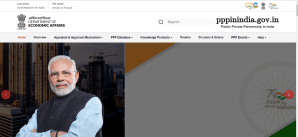
The Department of Economic Affairs, Ministry of Finance, Government of India maintains a website for all PPP related material at one place. https://www.pppinindia.gov.in/. This is one of the most useful online resources on Indian PPPs.
GOI (2011). Draft National PPP Policy. Department of Economic Affairs, MOF (26 pages). Available at: http://www.pppinindia.com/pdf/draftnationalppppolicy.pdf
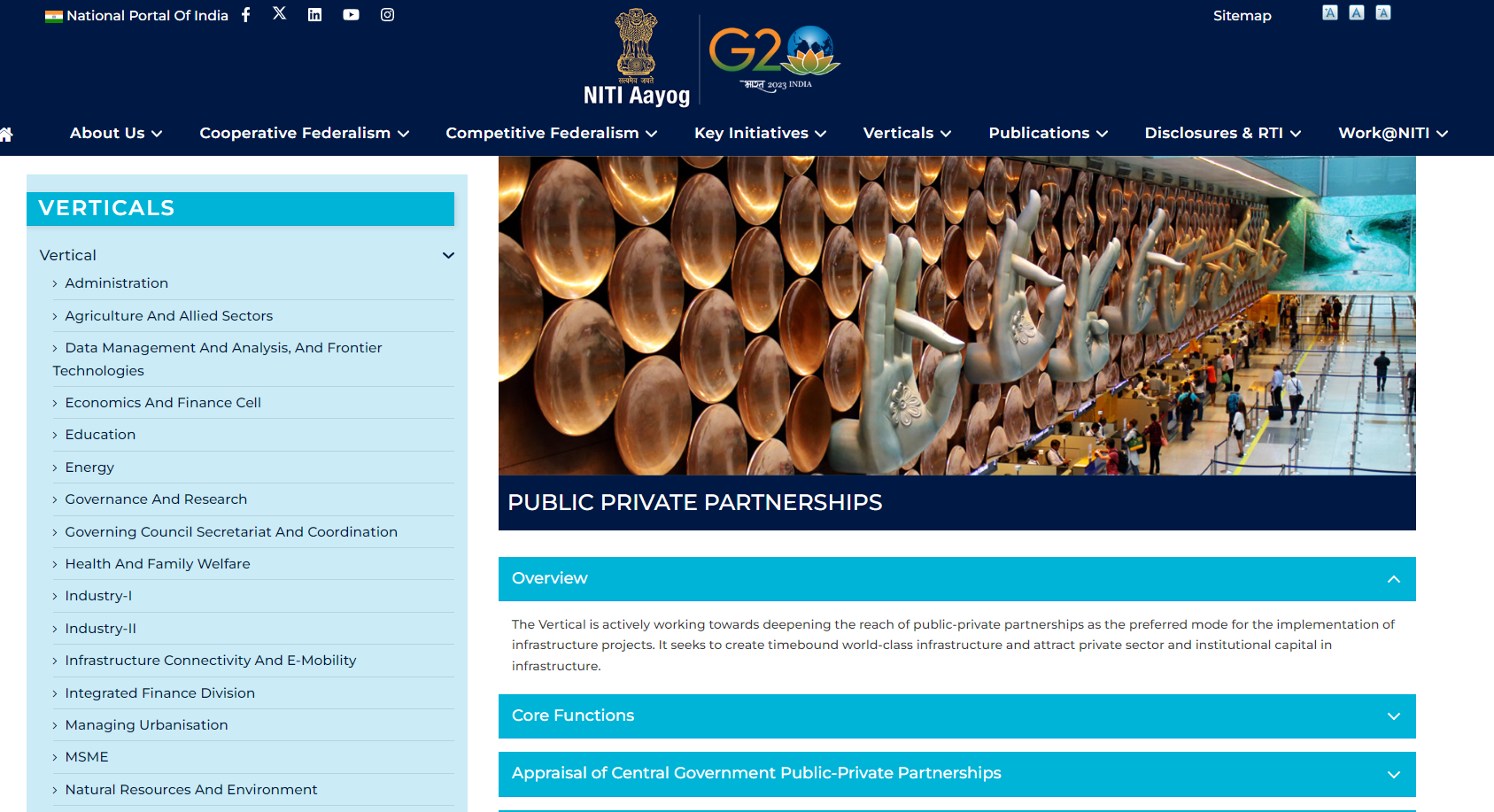
The Niti Ayog, India’s highesy policy making body, also maintains a page on PPPs. https://www.niti.gov.in/verticals/ppp
World Bank
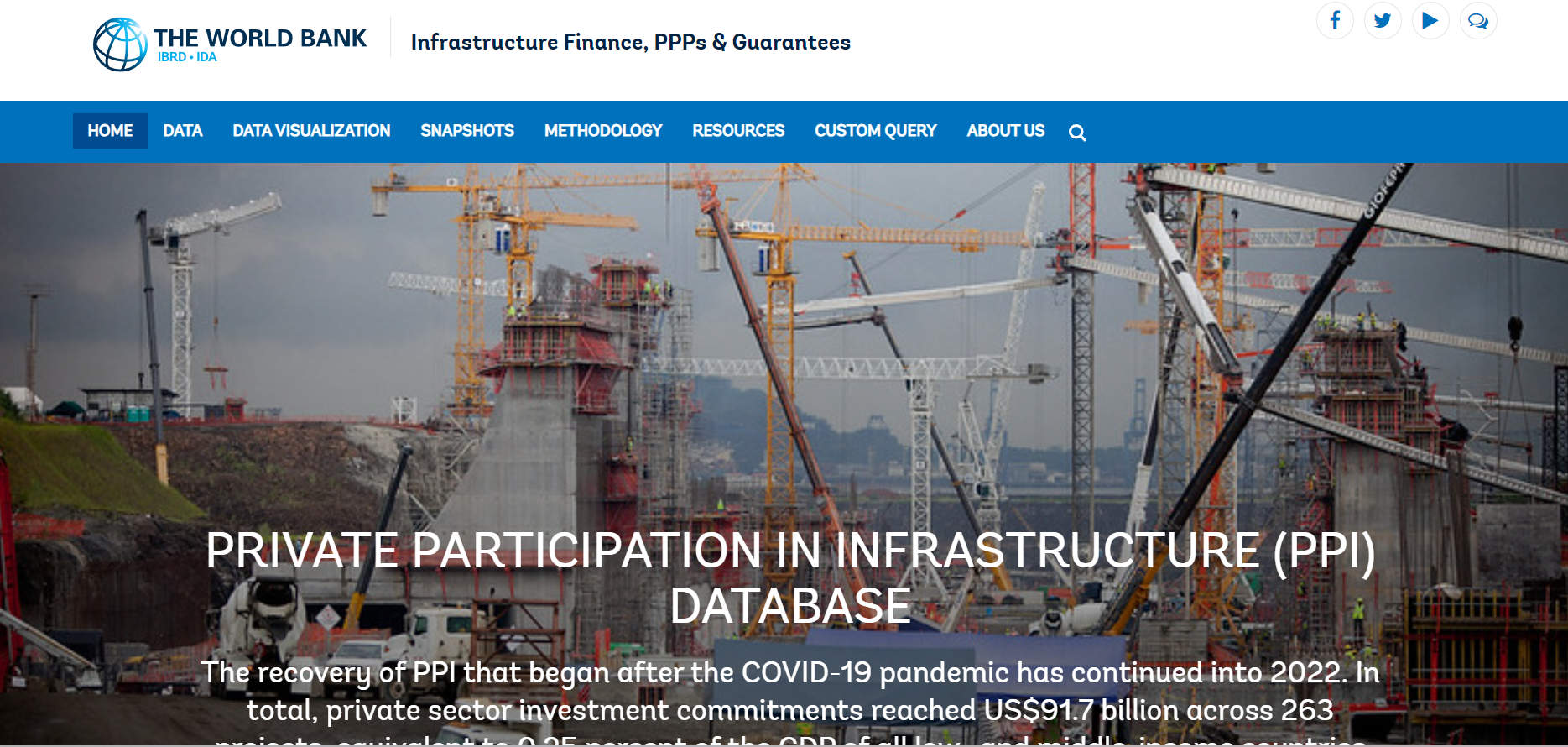
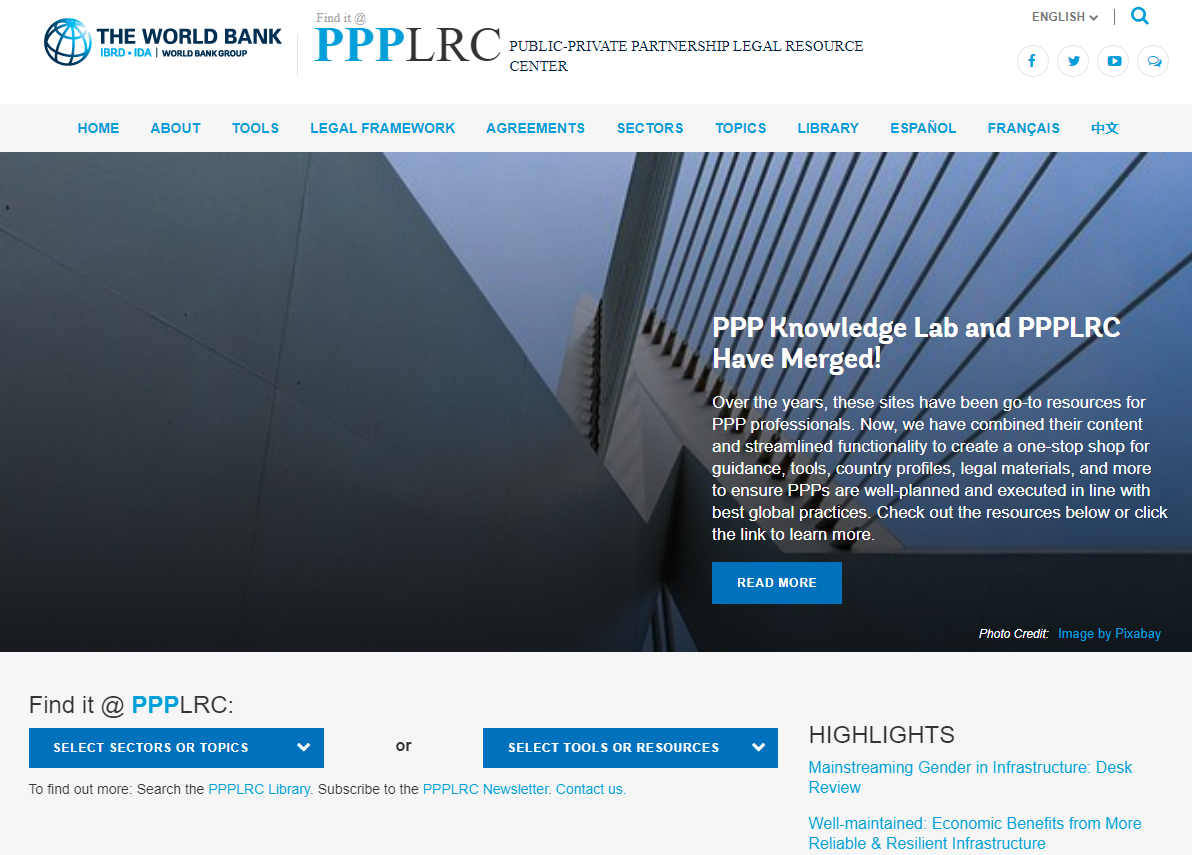
The World Bank, Infrastructure Finance Group, similarly maintains a resoucres bases for PPPs , which is of extreme high value. https://ppi.worldbank.org/en/ppi and https://ppp.worldbank.org/public-private-partnership/
 Swapnil Garg's home on the WWW