How management thinking can hurt sometimes!

Increasingly there is a recognition that management education may cause more harm then good. Harvard Business School is the favourite punching bag here, where the problems on the Wall Street are balmed on the Harvard style educated manager (HBR, PBS, Debate). Blaming ills of Wall Steet is however frequently attributed to personal greed, rather than management education. Based on my own personalm experience I propose to identify specific aspects where I can trace problems to what we had educated managers with in the management schools. The cases and instances that I identify (below, and seek tio build repository of the same overtime) converge into a central idea — missing the goal post — the ambiguity around the objective of any exercise or actvity! If there is a confusiion or lack of calrity about what we want to fundamentally achieve, management education will guide us to make a choice and decide on our objective, which could possibly be an incorrect choice as there is no broad guiding principle.

Take the case of cleaning a city. The city of Indore achieved a remarkable feat and ranked first in the national cleanliness survey for seven years in a row. A lot of hard work by public managers, citizen participation, alignment of politics and bureaucracy, and innumerable otehr factors contribute to this high achivement and its sustenance. After the intiiual bouts of success, the focus moved to sustenance. The initial efforts undertaken on misison mode, now required a management approach. And multiple efforts in this context were initiated. Cleanliness was a result of at soucre seggregation, door to door collection, effective transportation, waste processing, and a centralized coordination of the whole of the system. Soon, someone came up with the idea of optimizing the trasnportation as the city was running up huge diesel bills and as coverage increased, shortage of transport vehicles was felt. The management solution lay in optimizing the transport system in multiple ways. I enumerate a few below

a) Route optimizing and rationalization: This was aimed at increasing coverage and reducing distance travelled. Whiloe optimizing this, garbage was not collected when convenient to the public, but when the truck would reach your house as per the rationalized routing.

b) Vehicle capacity rationalization: To carry more garbage and reduce number of trips, the city decided to purchase trucks of larger size. 1.5 ton trucks were substituted with 3 and 5 ton capacity trucks. This would bring about operational effeciency, but it compromised the primary garbage collection objective. Putting garbage into larger trucks was now more difficult for the citizens, and it often spilled out. These trucks blocked streets and lanes, and garbage trucks which people used to welcoime before were now resented as they would block all movement.

c) Airport Facilities: The Indian airport sector has woken up to this perspective, though a little late. In the last 2 decades Indian Airports in a bid to improve and upgrade, had lost their way. Non-Aeronautical revenue which was aimed at making the airport viable for upgradation took central space, and the airports moved their focus from being a transport terminal to a shopping archade, and painfully the shopping archade principles took precedence over the transport utility. In a bid to fix this, in the year 2023, led by the Civil Aviation minister the balance was restored, when he openly identified six agenda items for airports to adopt, with one of them being — Move away from shopping mall structure and bring back passenger mobility to the front. The parking at the Indore Airport is an example which is still to be fixed. The road access side of the airports moves double the number of people who pass through the airport (for every passenger, there is a driver of the vehicle which dropped or picked him/her up), however scant attention is paid to this aspect. At Indore parking fees collection has been given precedence over smooth flow of traffic and convenience of passengers. The circulation area needs a complete redesign to smoothen out vehicle flow, rather than force vehicles to stand on the road waiting or wasting precious fuel moving around to save getting into the parking lot.

d) MORE INSTANCES to follow

So what is the issue… A typical management arena problem. A big task broken down into smaller parts (Adam Smith’s all pin manufcature story), and then we put it all together, in the hope that we would achieve cooperation (incentive) and coordination (rationality). But, departmenal or functional optimization results in a sub-optimization levels, compromizing the overall objective level. When does it happen? When there is a lack of clarity around the higehr level objectives or missing identfications of how the sublevel goals would contribute and align with the overall objectives- a common problem in public management systems, where multiple objectives exist simultaneously, and functional alignment is hard to achieve.

Public Procurement – Make in India

How does the Government of India give a boost to “Make in India”? The first and simplest option is buy Indian itself. With public spending or procurement amounting to as much as 15-40% (estimates vary by small or big government and categorization of spending) of a countries Gross Domestic Product (GDP), public spending is the natural first option for the different “Make Local” policies and an arena in which the government can show quick results.

Recognizing this, the Department of Industrial Policy and Promotion (Ministry of Commerce and Industry, Government of India), which was mandated to push the mission “Make in India”, to issue numerous policy circulars arguing for “Preference to Make in India”. This was well within the rules provided by GFR 2017 (Rule 153(iii)). But here comes the dichotomy…..

We want public procurement to be transparent, fair, economical, least price, efficient, equitable, and …… but we want to give a preference. However, this is not the first time that public procurement had faced such a dichotomy. This is an old fight… When quality and price compete, price wins in public procurement!; when delivery and price compete, price wins again in public procurement; when long term output compares with short term price decisions, price wins. So what happens in the “Make in India” program…

The policies of Government of India targeting “Make in India” stipulates that bidding in public procurement be done in the normal fashion and the L-1 bidder identified. If it is a local (eligible) Make in India go ahead. Otherwise, allot it part of quantity and let the lowest bidder in the local suppliers match the L-1 price! Price one, and Make in India lost! AGAIN!

Two alternatives exist. ON one hand, if a local bidder could produce and deliver at the L-1 price, than why did it quote at a high price? Presumably it was trying to be opportunistic in its price. On the other hand, if the local bidder cannot produce and deliver at the L-1 price (due to legacy issue, economies of scale, technology disadvantage, etc.) then it is suicidal on its part to match the L-1 bid and make a loss in supplying to the government. Then, why have this system — because L-1 is the mandate, and is the single biggest aim of Public Procurement. BUT, IS IT? We just now argued “Make in India” was also an objective! How does one resolve this.

This is a tricky issue, and no perfect solutions exist. However, the first step lies in recognizing this problem, and probably experimenting with a few approaches before finalizing on to one.  Here are some options..

a) Alternate selections: L-1 bidding is not the global norm for public procurement. Why should it be? Best / Highest Value should be the norm and not the lowest quoted price. The fundamental problem with L-1 is even ex-ante quality and delivery shading to win the price bid. Multiple solutions have been tried out for this. To name a few…

i) Vickery Auction — L-2 bid selection. The person who shades quality or delivery maximum is not the winner, but instead the next best person. There is no race to the bottom. However, there is an strong assumption that we have a highly competitive market, with no natural advantages for anyone.

ii) Average bid price auction — Median or Average bid price again makes a strong assumption of a competitive market, and expects the average or median bid price to reflect the true price of the product.

iii) Buyer determined reverse auction — Herein, reverse auction is held, however the buyer has a predetermined (and published criterion) based upon which it would select the bidders.

b) Quality-cum cost bids — If quantification of quality is possible, quality and cost need be weighted for finalization of bids– Our GFR however restricts this consultancy work only.

c) Reassessing public procurement limits — Financial limits for open or selected vendor bidding, limits for proprietary products or services purchases, limits for marketplace purchases, and the like have all been based upon market availability. Such limits are a global norm. However, the rigidity in these norms is not a norm. It may be required to base these limits on the need of the purchaser, rather than driven by the market. Trust and reliance has to creep in into the procurer, empowering him/her to use discretion.

For long we have made L-1 the scape-goat of most of public procurement ills. Most other ills of public procurement like insufficient specification, no use of discretion, lack of vendor development, missing partnership arrangements etc, have all been blamed on L-1. It is time we let go of L-1 go, experiment with some alternatives, and work towards improving the procurement process rather than hide behind lame excuses.


Swapnil Garg September 22, 2019


Who will pay for Railway station development?

In an interesting development, the TOI reports today…

Railway to charge ‘user fee’ at busy stations, tickets may c ..

Railways have been struggling with this for long, and the user fees idea has been existing for generations. The most significant change was when Airport’s started levying user fees (Delhi and Mumbai in 2008), and railways was to follow soon. Hence, the whole concern is WHY SO LATE?

a) They did not know

b) They felt they could never do it

I for one tend to believe in b) They felt they could never do it, but first what did they know.

Personal blogs are places where one can blow is trumpet, without being ashamed of it. So here I am.

While still with the railways, I did a project, where for one month I studied how could Lucknow station be made world class. With time at hand (I was on paid leave from railways, and was to quit in a month), I explored all possible ideas. And one of them was how to finance the stations re-development.

As part of a report titled (already existing here as part of an older blog entry) Rethinking PPPs: Building a world class railway station
A Proposal for Lucknow Charbagh Station
, I had argued for a user charge in the executive summary, with the following justification:

The justification for user charges follows from the analysis of users of railways stations. Preliminary figures show that the station is routinely handling 1-1.5 lac people per day, but needs to be upgraded to handle 2 lac passengers per day to cater to the peak loads. A railway passenger with reserved ticket was found to pay an average ticket price of Rs 500/-for his journey. Similarly, an unreserved passenger is proposing to pay Rs 100/- (on average) for his journey. Like airports, a station usage fees of Rs 20/- for reserved classes and Rs 10/- for unreserved classes, yields an additional revenue of Rs 70 cr per year, and is more than enough for what is required to provide world class facilities to our station users.

The TOI article, saying that ticket prices would increase, needs to be qualified properly. Once again the TOI reporter is shooting in the dark, to sensationalize.

Having made this proposal, I was inquisitive after leaving railways, as to why don’t they do it. I put up this questions at all levels. The answers, that I got were like (not taking names, but these were the people making proposals), ‘No one would allow us to add this charge’; ‘We are a public body, how can we charge for station usage’; or ‘Airport usage fees needs be removed, public service means free service’. None of these arguments are convincing enough within themselves, and simply reflect just “They felt they could never do it.”

This is a sad situation, as when the bureaucrat/policy maker feels constrained to take honest and well meaning actions, one can hardly expect much from the organization.

Read more at:
http://timesofindia.indiatimes.com/articleshow/78178494.cms?utm_source=contentofinterest&utm_medium=text&utm_campaign=cppst

Public Procurement – Make in India

How does the Government of India give a boost to “Make in India”? The first and simplest option is buy Indian itself. With public spending or procurement amounting to as much as 15-40% (estimates vary by small or big government and categorization of spending) of a countries Gross Domestic Product (GDP), public spending is the natural first option for the different “Make Local” policies and an arena in which the government can show quick results.

Recognizing this, the Department of Industrial Policy and Promotion (Ministry of Commerce and Industry, Government of India), which was mandated to push the mission “Make in India”, to issue numerous policy circulars arguing for “Preference to Make in India”. This was well within the rules provided by GFR 2017 (Rule 153(iii)). But here comes the dichotomy…..

We want public procurement to be transparent, fair, economical, least price, efficient, equitable, and …… but we want to give a preference. However, this is not the first time that public procurement had faced such a dichotomy. This is an old fight… When quality and price compete, price wins in public procurement!; when delivery and price compete, price wins again in public procurement; when long term output compares with short term price decisions, price wins. So what happens in the “Make in India” program…

The policies of Government of India targeting “Make in India” stipulates that bidding in public procurement be done in the normal fashion and the L-1 bidder identified. If it is a local (eligible) Make in India go ahead. Otherwise, allot it part of quantity and let the lowest bidder in the local suppliers match the L-1 price! Price one, and Make in India lost! AGAIN!

Two alternatives exist. ON one hand, if a local bidder could produce and deliver at the L-1 price, than why did it quote at a high price? Presumably it was trying to be opportunistic in its price. On the other hand, if the local bidder cannot produce and deliver at the L-1 price (due to legacy issue, economies of scale, technology disadvantage, etc.) then it is suicidal on its part to match the L-1 bid and make a loss in supplying to the government. Then, why have this system — because L-1 is the mandate, and is the single biggest aim of Public Procurement. BUT, IS IT? We just now argued “Make in India” was also an objective! How does one resolve this.

This is a tricky issue, and no perfect solutions exist. However, the first step lies in recognizing this problem, and probably experimenting with a few approaches before finalizing on to one.  Here are some options..

a) Alternate selections: L-1 bidding is not the global norm for public procurement. Why should it be? Best / Highest Value should be the norm and not the lowest quoted price. The fundamental problem with L-1 is even ex-ante quality and delivery shading to win the price bid. Multiple solutions have been tried out for this. To name a few…

i) Vickery Auction — L-2 bid selection. The person who shades quality or delivery maximum is not the winner, but instead the next best person. There is no race to the bottom. However, there is an strong assumption that we have a highly competitive market, with no natural advantages for anyone.

ii) Average bid price auction — Median or Average bid price again makes a strong assumption of a competitive market, and expects the average or median bid price to reflect the true price of the product.

iii) Buyer determined reverse auction — Herein, reverse auction is held, however the buyer has a predetermined (and published criterion) based upon which it would select the bidders.

b) Quality-cum cost bids — If quantification of quality is possible, quality and cost need be weighted for finalization of bids– Our GFR however restricts this consultancy work only.

c) Reassessing public procurement limits — Financial limits for open or selected vendor bidding, limits for proprietary products or services purchases, limits for marketplace purchases, and the like have all been based upon market availability. Such limits are a global norm. However, the rigidity in these norms is not a norm. It may be required to base these limits on the need of the purchaser, rather than driven by the market. Trust and reliance has to creep in into the procurer, empowering him/her to use discretion.

For long we have made L-1 the scape-goat of most of public procurement ills. Most other ills of public procurement like insufficient specification, no use of discretion, lack of vendor development, missing partnership arrangements etc, have all been blamed on L-1. It is time we let go of L-1 go, experiment with some alternatives, and work towards improving the procurement process rather than hide behind lame excuses.


Swapnil Garg September 22, 2019


Public Procurement – Its importance

Concerns about public procurement have occupied a central space in Indian Media for two decades now. Since the Bofors scam, there has been no looking back.. We have had the Coal Scam, 2G Scam, Common Wealth Scam, and more recently some call it the Rafael scam.  Central to all of them is public procurement! While being a great subject for new paper headlines and a as a beating stick for politicians and bureaucrats, it has been of little interest for academicians,  professionals, and policy makers. I see some paradoxes here

a) Everyone does public procurement, hence everyone knows it: Incorrect.

Just because everyone does it does not imply that everyone knows it. Firstly, most people have not been formally trained it, and they have learned on the job. And secondly, if everyone knows about it, why do we have so many scams.

b) There is little to it, other than rules and procedures: Incorrect.

During my last count, there were six Nobel laureates in the filed of economics who had been recognized primarily for their contributions to procurement related works, and specifically public procurement. The ideas of incomplete contracts, contract theory, bundling, regulation, public and private good, long term contracts, common pool resources, etc, are all tough things to conceptualize theoretically. If they are enough to get someone a Nobel prize, it has to be something more than well documented rules and procedures.

Secondly, not everyone scam or everyone bureaucrat is dealing with following of rules. Scams have taken place when rules were redrafted and rewritten by the bureaucrats. However, those who write these rules are often no more wiser than those who had been following the rules. A fundamental recognition of what rules say, and why they say it is important for both — those who make rules and those who are to follow them.

c) It is the routine job and that of a low paid clerk: Incorrect.

There happen to be two levels here — procurement manager and procurement clerk. First the later — the procurement clerk. Yes, this is routine job and is often a low paid one. For this very reason, do not even expect this job to exist for long. The machines would take over, if they not already done. Procurement have become e-enabled.  There are no more large thick files, maintained by clerks following procedures. Our dog-headed perusal of rules and regulations has moved procurement to the work of bots and block chains, after ERPs and e-tending portals.

However, the second    — procurement manager is more interesting. The procurement managers role is not going anywhere. The procurement manager is the one who exercises discretion in purchasing decision making and who decides what rules to make.

As per ranking of 772 occupations to their survival probability in face of computerization, while the procurement manager ranks 146 and only has a 0.03 probability to get computerized, the procurement agent ranks 458 with a 0.77 probability to be computerized, and the procurement clerk ranks 715 and has a 0.98 probability to get computerized.

d) Public procurement is more about following rules, so there is not thing to learn when you know the rules. Incorrect

As identified above, the rule based decision making would get automated. It is the more higher value, long term contracting, strategic procurement, sensitive procurement and the like which needs attention, and the numerous scams happen in these areas. Firstly, it is of utmost importance to identify what is routine and what is strategic, and secondly what makes them so. Where is discretion required to be exercised, and what should guide exercising of discretion. Atleast public procurement does not allow one the freedom for — I did it because I felt like doing it!  One has to explicit and hence needs to know what to be explicit about.

e) There is no where to learn about it: Partially correct.

Learning about procurement leads one to slide presentations which copy and paste from codes and manuals — awareness sessions. There are a number of such learning opportunities, however, the academic in me detests them. Codes and manuals are required to be referred to, and not taught. Teaching them is a formal way of singing a lullababy in class, and little value addition to the audience.

With this recognition, my public procurement sessions steer away from codes and manuals, but instead attempt to identify the key ideas which drive the motivation of the codes and manuals. Hence, I rarely go beyond the preface and introduction, as class is oriented around identifying the manner in which the objective of the code/manual (stated in the introduction) gets covered in the contents of the document– identifying and drawing out the links.

However, there are a couple of good learning opportunities:

i) National Institute of Financial Management, Faridabad, Haryana runs a one week module on Public Procurement. When I last looked at its contents and schedule it looked interesting.

ii) AIMA and World Bank run a certification program on public procurement. This distance learning program has a number of interesting contents, and above all this may be the only formal certification course on the subject.

As a professional disciple, the subject of public procurement is important, having learnt it on job not all of us experts at it, it is more than simple rules and procedures, it is not routine and there do exist a few learning opportunities/ courses here. To summarize, the subject of public procurement has received little attention as professional subject of interest, despite repeatedly occupying media headlines. It is time it is given its due, and moved from media space to mental space of decision makers!

REFERENCE: THE FUTURE OF EMPLOYMENT: HOW SUSCEPTIBLE ARE JOBS TO COMPUTERISATION? Carl Benedikt Frey and Michael A. Osborne

Let us play the game — Train 18, 19, 20…. or 18, 18 and 0,0,0……..

Dear (To whom so ever it may interest),

A month and a half later, I am no longer angry, disillusioned or losing hope! I realized that I should have already lost hope by now and it was now only a matter of realization. These articles are helping in the realization …….

a) Facing favouritism charges, Railways introduces fresh tender system for Train-18. (http://www.railnews.in/facing-favouritism-charges-railways-introduces-fresh-tender-system-for-train-18/).

b) Chinese Companies May Enter Race in a Big Way for Vande Bharat Manufacturing )https://thewire.in/government/chinese-companies-may-enter-race-in-a-big-way-for-vande-bharat-manufacturing)

I have no reason to doubt the contents of the articles, hence I continue….

What does these articles say :

a) Production of the third Train 18 unit virtually stopped.  — READ — Dead before starting — The parts of the first two were ordered together in the first attempt, and based on trains performance the journey was to be taken forward — but the next steps have been halted!

b) Specifications provided by RDSO (Research Design and Standards Organisation (RDSO), Lucknow, which functions as a technical adviser and consultant to the railways,) were not followed by the ICF during manufacturing of first Train 18 set. — READ — Approval to be taken from an organizations which has till date not designed anything and has no rolling stock designs stand to its name — Diesel Locomotives (General Motors, ALCO), Electric Locomotives (ABB, Hitachi, Siemens and even BHEL), Coaches (ICF, Schelerin, LHB — IR-X and IR-Y never took off), — only success to its name is in designing wagon bodies with Casnub bogies (which are to a US design).

c) Department of industrial policy and promotion (DIPP) red-flagging the process. A vigilance enquiry underway at the Integral Coach Factory. — READ — Minister of Railways is also the Minister of Commerce (Head of DIPP). There are only two ways that such enquiries end up — i) Find something to prove what the boss says (create something or misinterpret something and award blame for putting a comma in the wrong place)! And if you cannot find something delay and delay (finish off someones career) and finally give a clean chit (when the boss retires). The system is not designed to catch the thieves — thieves are always smarter than the police!

d) Allegations of favouritism in the tendering process of the first train set — a domestic private firm was allegedly favoured in the procurement process for electrical equipment for the train set. — READ — DIPP’s flagship program is “Make in India”, and its officers are fighting for a level playing field for Indian Vendors, as Indian Public Sector prefers imports. And now someone favors(if it favors) the domestic firm and delivers….. and we do not like it…. Do we want to Make in India or provide a level paying ground in India to foreign (Chinese) firms? It is actually bureaucratically safer to keep howling Chinese government gives unfair advantages to its firms rather than retaliate and play an aggressive game, and be blamed for favoring an Indian Firm (a matter of national pride) but at the risk of favoring a national firm.

e) ICF has been sanctioned to manufacture 40 Vande Bharat train sets over the next three years – 10 in 2019-20 and 15 each in the next two years.  AND The Railway Board in a recent meeting with top officials and leading manufacturers of propulsion systems discussed the new timelines to invite wider participation. READ — for 40 Vande Bharat train sets, and with 18 vendors participating, there would be plans of 4-5 different technologies to be simultaneously running in the organization, how does that sound?  If you select one there is favoritism, if you select many there is not enough volume for any one — The existing vendor rejected the repeat order when quantities were reduced significantly….

f) An official said, “We want to offer a level playing field to all suppliers to participate in the making of these trains which will not only have high quality but (will be produced with) much greater transparency.” — underway.

For the last– some quotations from Indians who have achieved success in delivering technology using public sector systems — Let us take two exemplars — Mr. R.C.Sinha (of Mumbai-Pune Expressway fame) and Mr E Shreedharan (Konkan Railway and Delhi Metro fame) — Some notable excerpts — But mind it — These seasoned public servants have gone on record saying these things (they have gone ,

Mr. R.C.Sinha’s way of working

  • “They realized that in a commercial system, some amount of risk has to be taken.:
  • “Technical evaluation of these tenders (55) were completed in about 7 days time and it was found that slightly less than half the number of contractors did not meet the tender qualification criteria.”
  • “I accepted the findings and recommendations of the Technical Committee, without any modification”
  • “evaluation of tenders estimated at Rs. 633 crores and issues work orders within a period of 13 days ” — 1998 Value
  • “This offer was rejected on the grounds of “not workable” and “not responsible tender” and the work was assigned to the second lowest contractor.”
  • “All those reasons, which could be the cause for delay, were eliminated and MSRDC took upon itself the role of coordinator and  facilitator. “

Mr. Shreedaran’s way of working

  • Critics could say that his plans were not prudent or that some of his actions were downright illegal.
  • They(contractors) began the work earnestly without even a shred of paper to show for confirmation of their contracts.
  • Inviting tenders for construction on a property which had not been released from due process technically made for operating outside the law.
  • Not all contractors were invited to tender for the jobs.
  • To make a major variation in cost and contract: Sreeram’s apprehensions were about the approval and budget needed for the additional work. He told Shreedharan so. ‘That should never be an issue. Let me worry about it.”
  • “Shreedharan and his team did not adopt a policy of strict adherence to the book. “
  • When inflation was skyrocketing, the contracts were renegotiated.

It is easy to see that the projects that these stalwarts delivered were not delivered in the conventional way in which we understand fair, equitable and transparent manner.  Fairness, equity and transparent are important, but subjective judgement and noble intentions lie above that. Aspects of timely and under cost delivery of Train 18 stands for both sound subjective judgement and noble intentions — 18 months from design to delivery and Rs 97 crore per train!

Only three concluding points:

i) Natural justice argument: Inquiring into past decisions with a broken lens (with no emphasis on delivery and instead use of rule book procedures for checking transparency, fairness, and transparency) is against natural justice as delivery is being kept out of the evaluative matrix.  If an inquiry is to be done, put on the lens of Mr. Sinha and Mr. Shreedharan (salient points identified above) for a pear to pear comparison.  An evaluation of the executed instructions with conventional public sector measures of transparency, equity and fairness is in itself a non-transparent, non-equitable and an unfair evaluation!

ii) Competency argument: No time is lost, and there is also a precedent now — Let us put in a new system of tendering and deliver the 3-6th rake of Train 18 in 18 months — Let us say December 2020. Let us say who in this organization takes this up as a challenge! Of course, if achieved we can scrutiny both the efforts on similar transparency, equity and fairness parameters — We will have a pear to pear comparison.

iii) and lastly, the pragmatic approach: Post-mortem is done on a dead man — imagine what would happen if you do a postmortem on a live person. Hopefully, the same would not happen when you do a post-mortem of Train-18 files — It is fine if you do not want to revive it!

I am fine with all three, you can take your pick…..

(Full context of the above excerpts is reproduced below — with exact references.)

BACKGROUND MATERIAL: 

ONLINE NEWS ARTICLE: Facing favouritism charges, Railways introduces fresh tender system for Train-18. (http://www.railnews.in/facing-favouritism-charges-railways-introduces-fresh-tender-system-for-train-18/)

Facing favouritism charges, Railways introduces fresh Tender System for Train-18

Officials said the manufacturing process for the third Train 18 set, or Vande Bharat Express, would go on now with the new tendering process in place.

NEW DELHI: With the production of the third Train 18 unit virtually stopped over allegations of favouritism in the tendering process of the first train set, the railways Tuesday said it has introduced a new system for giving all bidders a level playing field and ensuring transparency.

Officials said the manufacturing process for the third Train 18 set, or Vande Bharat Express, would go on now with the new tendering process in place.

Earlier, stung by allegations of favouritism in the tendering process for manufacturing the first Train 18 set, which was rolled out earlier this year, the Integral Coach Factory had scrapped all existing tenders for the third rake.

A second Train 18 set is ready and is likely to be launched next month on the Delhi-Katra route.

Officials said the new tendering process gives vendors three months to apply for bids instead of the present three weeks.

It makes it mandatory for the production units to follow Research Design and Standards Organisation (RDSO), Lucknow, which functions as a technical adviser and consultant to the railways, specifications while issuing a tender, which was not followed by the ICF during manufacturing of first Train 18 set.

“This will bring in more transparency and also give all parties a level playing field,” an official said.

The first rake of Train 18 was manufactured in a record time of just 18 months at a cost of about Rs 97 crore.

However, the ministry received around 25 complaints from vendors and multinational companies that a domestic private firm was allegedly favoured in the procurement process for electrical equipment for the train set.

During the bidding process for the first rake, 18 companies were in the fray for supplying electrical equipment. Eight of these firms were Indian.

However, only one consortium could make it on the last day of the tender submission, February 6, 2018, due to “certain pre-bidding conditions”, sources said, though they did not elaborate.

This led to the department of industrial policy and promotion (DIPP) red-flagging the process. And the manufacturing of the third train virtually stopped with a vigilance enquiry at the Integral Coach Factory underway.

Not just the Integral Coach Factory (ICF), Chennai, but the Modern Coach Factory, Rae Bareli, also cancelled all tenders pertaining to Vande Bharat Express type of rakes, suburban trains such as Electric Multiple Units (EMU), Diesel Electric Multiple Units (DEMU) and Mainline Electric Multiple Units (MEMU) as well.

An official said, “We want to offer a level playing field to all suppliers to participate in the making of these trains which will not only have high quality but (will be produced with) much greater transparency.”

The Railway Board in a recent meeting with top officials and leading manufacturers of propulsion systems discussed the new timelines to invite wider participation, another official said.

“The Board met train set manufacturers and informed them that train sets could only be procured from them if the demand exceeds the manufacturing capacity of railways’ production units,” the senior ministry official said.

The ICF has been sanctioned to manufacture 40 Vande Bharat train sets over the next three years – 10 in 2019-20 and 15 each in the next two years.

SOURCE FOR Mr. R.C.Sinha’s Quotes:

Article available on line at multiple places…

This article is a transcript of a lecture delivered by Shri.R.C.Sinha, Former Addl. Chief Secretary, Government of Maharashtra and Vice- Chairman and Managing Director, Maharashtra State Road Development Corporation Limited on March, 25, 2000 in  a lecture series on “Ideas that have worked” organized by Department of Administrative Reforms and Public Grievances, Government of India in collaboration with Civil Services Officers Institute and Government of Andhra Pradesh. The invitees for the lecture series mainly were officers to Government of India, Members of the Civil Services Officers Institute, diplomats, CEOs of selected public sector undertakings, industrialists, researchers and trainers, some invitees of the Government of Andhra Pradesh and a selected group of media personalities.

Page 4: The Board of Directors approved  the appointment of the technical consultants, fully realizing that in case the required  clearance is not obtained from the  GoI MoE & F, the entire expenditure on technical consultancy will become infractuous. They realized that in a commercial system, some amount of risk has to be taken.

Page 5: 133 tenders were sold and 55 tenders were received on 18.12.1997. Looking at the capacity of the contractors, tenders provided that not more than one section will be assigned to any contractor. Technical evaluation of these tenders were completed in about 7 days time and it was found that slightly less than half the number of contractors did not meet the tender qualification criteria, as had been prescribed in the tender document.

Page 6: The consultants with the help of the Chief Engineer did the technical evaluation and it was evaluated by the High Power Steering Committee consisting of officers from MSRDC and outside technical experts. A combined report was submitted to me in my capacity as MD. I accepted the findings and recommendations of the Technical Committee, without any modification.

Page 7: The Board of Directors in its meeting held on 31.12.1997 approved the proposal and work orders were issued on1st January 1998. It was a great achievement on our part to do evaluation of tenders estimated at Rs. 633 crores and issues work orders within a period of 13 days. It is also to be noted that our tender estimate cost was Rs. 632.54 crores and the tender amount was Rs. 627.85 cores. One of the projects where the estimated cost and tender amount came very close to each other with 10% and a saving of about 5 crores.

Page 6: However, no Writ Petitions were filed and no stay orders given in any of the projects of MSRDC. The other problem that was faced by us was when one of the contractors for Section “D” quoted a price, which was so low that the consultants, the High Powered Steering Committee and myself were convinced that it was not at all workable. This offer was rejected on the grounds of “not workable” and “not responsible tender” and the work was assigned to the second lowest contractor.

Page 7: All contractors were of the opinion that with a project of this magnitude and complications  involved, it would take not less than 48 months. The contractors further stated that a lot of their time was spent in obtaining the different permissions, sanctions, provisions and the non- availability of land for the construction. This causes delays as during these periods work comes to a standstill.

Page 8: The use of the modern machinery has been made compulsory. It was estimated that the project would need about 8000 KVA of power. MSRDC entered into an agreement with MSEB and paid the amount for putting up 8 Electric Sub-Stations on the alignment to ensure smooth availability of power supply. Similar payment was made for shifting of high tension power lines both to MSEB and Tata Power Supply. For the construction of the Expressway, 300 crore litres of water is expected to be consumed. Water sources on the alignment were identified and blanket permission obtained from the Government for the use of water from these sources for construction purposes, except one used for drinking purposes.

Page 9: Lands were also identified for offices of contractors and PMC to be by the side. In short all those reasons, which could be the cause for delay, were eliminated and MSRDC took upon itself the role of coordinator and  facilitator. To perform the role of coordinator and facilitator, the staff had to be extremely motivated  and as the work started the whole staff right from the lowest to the highest level geared to top level of performance. They accepted the challenge of doing the work of quality and in time. They were made to develop a sense of pride in their performance and feel part of history being made in the construction industry. Extremely motivated staff and officers of MSRDC, consultant and contractors became the biggest asset of the whole system.

Page 9: The bills submitted by the contractors were to be verified within 10 days of receipt and sent to MSRDC for payment. The tender document stipulated that payment will be made within 7 days failing which MSRDC shall be bound to pay interest to the contractor.

Page 10: I would like to add here that MSRDC also decided to reimburse import duty on specified machinery and also foreign exchange fluctuations on the same.

Page 15: Decisions taken in these meetings were noted for implementation and there was no need to further confirm these decisions. The on -site meetings enable even small thorns to be removed.

Page 20: The last in milestone is more important and in case contractor achieved last milestone within time i.e. total completion, it was agreed that penalty paid by contractor for non -completion of intermediate milestone would be refunded.

A Book on Mr. Shreedharan — A bipgraphy by R Ashokan 

Excerpts from Book available online at https://www.amazon.in/Karmayogi-Biography-Sreedharan-Ashokan/dp/0143425307/ref=sr_1_1?keywords=shreedharan&qid=1563613860&s=gateway&sr=8-1

Pg 135—Critics could say that his plans were not prudent or that some of his actions were downright illegal.

Pg 131 – At start of the Konkan railway project, ” Sreedharan met with a few contractors who had been working with the railways in mangalore. He let them know that the paperwork would take a couple of months more to finish at the office of KRCL, but they had to get to work right away, Now, this was a not a practice the railway was known for. Quite possibly, this would invite audit objections. Knowing Sreedharan’s methods and style of functioning, however, the contractors, on their part trusted him completely. They began the work earnestly without even a shred of paper to show for confirmation of their contracts. If, so far, they had been doing business ranging in lakhs of rupees, this time they were undertaking projects of the order of crores of rupees, staking everything they had, solely based on their trust in Sreedharan.”

Pg 135 – “Inviting tenders for construction on a property which had not been released from due process technically made for operating outside the law. Those who had learnt to prize the value of time would agree that waiting forever, on the other hand, could be no less foolhardy. However, groups with special interest could very well criticize Sreedharan’s approach to legal technicalities and block his mission, which we have seen as recently as with the Kochi project, where the devious collusion of such forces got them tactical victories”

Pg 145 – Sreedharan and his colleagues knew that a project of this nature depended heavily on the contractor’s performance. ….. Not all contractors were invited to tender for the jobs.

Pg 147 – “Decisions were taken on the spot when it was so required. The fast and ambiguous directions that came as a result of the process Sreedharan had set in helped accelerate the project’s progress. P.Sreeram, who had been with Shreedharan since 1970, recalled an incident during  his time in Konkan. Construction of a major tunnel was on, and the work progressed, the machine got struck in a huge rock. Sreeram explained the situation to the CMD, who happened to be at the site. There was no option but to stop the day’s work, except if another tunnel was bored to remove the day’s work, Sreeram suggested. “Then we are doing it,’ Sreedharan said. Sreeram was not sure when he could start working on the second tunnel. ‘Right now!’ Sreedharan responded as though this question should never have been raised. Sreeram’s apprehensions were about the approval and budget needed for the additional work. He told Shreedharan so. ‘That should never be an issue. Let me worry about it. What’s worse would be halting the work. Time is precision. Do not delay. Let’s begin.’ As soon as Sreedharan finished his sentence, the machinery began to hum and charge to work. That was Shreedharan’s style of functioning.”

Pg 148 – “Shreedharan and his team did not adopt a policy of strict adherence to the book. “

Pg 148-149 “For instance when inflation was skyrocketing, the amount paid became insufficient for the contractors  who were working on a few tunnels. Having been convinced of their arguments validity, shreedharan agreed to review their rates. In the larger interest of the corporation, though, he negotiated with them. On certain occasions, he had to go beyond the agreements in the original contracts. However, none of those actions raised a single doubter’s brow.”


WCTRS 2019

World Conference on Transport Research’ 2019.

  • One of the biggest conferences in the transportation area.
  • Held once in three years and hosted for the first time in India at IIT, Bombay.
  • Registration of over a 1000 delegates, 65% international.
I presented two research papers, which had gone through the review process of the conference. The papers find a way into the journal “Transport Proceedia”.
I also hosted a Special Session. It had Prof. G Raghuram (IIM, Bangalore) and Prof. Thillai Raja (IIM, Madras) as the speakers, besides me. This session was conducted as part of the PPPINDIANET (a virtual network of PPP researchers in the country), which I am coordinating. During the session, we launched a database (developed by a private firm in collaboration with IIT, Madras). This found mention in the “The Hindu Business Line — Online edition”.

Is the commercialization of a public engineering organization complete?

This a heartfelt appeal to the Indian Railway’s top management to wake up and prevent the complete commercialization of a public engineering organization that is the lifeline of the nation.

The latest railway accident of Utkal express (19th August 2017), resulting in death of 23 and removal of ME, GM, DRM, CTE,  Sr.DEN etc. is a glaring example of what has gone wrong with the Indian Railways over time. Such accidents, which are primarily designed by humans by commission or omission, hurt deeply. Ironically, once again, there are no signs of addressing the core issues, but rather at dousing the fire, and killing the symptoms, rather than the disease.

One just need to talk to one of the 13,00,000 + railway employees and arrive at a list of ills in the organization. Thse range for erosion of dedication and sincerity, poor recruitment policies, over staffing, over-emphasis on passenger amenities at the cost of safety items, etc. The list is endless and everyone has his own unique understanding of the problem. But, is this not common in the case of any organization? What gets consistently missed in this long list is the recognition that a primarily engineering organization is getting progressively commercialized! The people at site have been punished, and accountability fixed to the highest levels in the organization. This is like any commercially run professional organization, and the mission seems to have been accomplished in making railway staff responsible for their actions. But this leaves one wondering — will these actions prevent the second accident of Utkal Express at the same place?

Some facts. Trains run on steel rails, and the steel rails have to be continuous. One of these rails developed a crack which was detected at noon (12:00 hrs). Till 17:46 (more than 5 hours later) when UTKAL express ran off the rails at this point, the tracks had not been closed down for repairs. It was being debated upon between operating managers and their engineering counterparts—should we close the track or not! No one realized that if there is no track, there are no trains to be run.

The response! On well recognizes that accidents of this magnitude do not happen by the fault of one! Firstly, those who faltered in fixing the track have been taken up. They should be. Everyone in the hierarchy – ranging from all those at site to the one in the Board should be sacked summarily, as they failed to recognize the importance of their work. They had completely missed the fact they are playing with the lives of public, and their jobs are a small part of it. I fully stand by the sacking of PWI to the Sr.DEN! Knowing the guts of system, I can draft their list offences in exact detail identifying how they contributed directly to the accident. Each of them were aware of the incident in realtime, but played it safe personally – to make railways unsafe for the public. Why was the rail cut without the block, and why was the banner flag not put up, are some of the failures for which they are directly responsible. This makes the people responsible for maintaining the track responsible.

Secondly, and more important—- who made them do that! For this, the removal of the DRM, CTE, GM to the ME becomes justifiable. They did not know of the incident in real time, but by their repeated actions and inactions they were responsible for the actions of their men!

However, we have all been silent about one part! What about the traffic department (operations the holy cow) who have refused to allow time for maintenance, or the engineering departments heads who could not put enough courage in their men to stop a train from running on a broken track! A key and important part here has been played by traffic department, which has cleverly become a hero here (while being the key instigator behind the crime). The full brass of operating people needs to be taken up similar to engineering and fixed. That is, those involved with the incident in realtime (section controller, Chief controller, DOM) and those behind the scene who had given the courage to behave the way that they did (which includes the CFTM/CPTM/COM the Operating equivalent of CTE, and the Operating equivalent of ME at the board level i.e., MT).

To make the role of operating more obvious one needs to know that the allotment of time for maintenance is an age-old problem in railway working. It is a tussle between the engineering and the operations since the railways started operating. One of the primary agendas for cross functional incharges (the DRMs and GMs) has traditionally been to maintain this delicate balance. Time had to be allowed for maintenance, at the cost of punctuality and moving higher traffic! And, there were times when this was fought tooth and nail, when people believed in the importance of their work. In the Indian Railways, the key problem has always been that while railways is a complex engineering institution, ironically in our case it is run by social science professionals. With time, the engineering has become secondary to operating/commercial interests, and result is obvious in this accident.

My prior experience with railways makes me fear that engineering will once be punished, while the operating will once again go scott free, making the organizations transition from the engineering to commercialization complete. This is not the last Utkal express accidents, but only one of the many which keep happening increasingly in the railway system, while it looses its engineering sheen!

ONE OF THOSE ROUTINE RAILWAY JOURNEYS!

Now,I travel far less by train compared to what I have done during most of my railway life. These are some observation during one such train journey in August 2017, and written while on the train. Railways is a huge system, with a very capable set of people, but it has been delivering far less than what it is capable of. In this piece, I identify two reasons which could lie behind this.
 The railway system fails to systematically learn from failures.
o The system is too busy hiding, defending, and negotiating failures, that there is little energy left for systematically learning from failures.
 There are far too many ears and eyes inspecting, compared to the minds and hands at work.
Below I attempt to qualify each of these conjectures with some examples.
LEARNING FROM FAILURES
As I look outside the train window, I see multiple rakes of covered goods wagons roll by. These were the BCNA wagons that had given me many restless nights during my railway days. The conventional covered wagon had been redesigned in 1990’s to increase its loading capacity. This also led to its doors getting modified for easy loading and unloading. Launched and celebrated as a great innovation it soon emerged that during train running the doors would open out, and break signals and other fixed structures. This became an operational nightmare, with trains behaving as torpedos. After numerous attempts of hiding, defending, and negotiating, the failure was recognized and it was decided that the doors would be redesigned for new wagons, and also modified in existing wagons. Wagons were called back and refitted with modified doors. A huge failure, which would have cost railways crores of rupees.
Firstly, is there an estimate of what the mistake costed railways! While we do have guess estimates of what the challenger crash costed, or what the titanic sinking costed, but we have never cared to estimate the cost of this failure. If you don’t measure it, you are unlikely to address it. Secondly, mistakes happen, and when one attempts new ideas they happen more often. But, these mistakes are supposed to pave the steps to success. I wonder, what the railway management’s take away was from this failure, other than ensure that changes to proven design not be made. Thirdly, was this a one-off failure? We would never know! We never got it studied and never got it documented.
Sitting in one of the most modern coaches over the railway system, every ten minutes I am subjected to a longitudinal jerk. This jerk, a decade after the introduction of LHB coaches, is enough evidence that little learning has happened from failures! This problem is known to railway managers from the first time that they ran trials on LHB rakes, and it still exists a decade later! There are many more such failures – rail fractures, OHE snapping, etc. which I can name. And, many more of those which go unnamed in the railways failure investigation, getting attributed to law order or cow runover! For instance, buckling of track in extreme winter, to which we never even attempted to find solutions to!
It would not be out of place to argue that the significant improvements in railways overtime are largely technology driven, and not because of learnings from failures. Most of the things within the direct sphere of influence of railway managers have remained the same, with little visible improvements on their own (for instance poor quality in purchase). Even office cleanliness and efficiency in procurement had to be externally driven by the prime minister and technology respectively.
INSPECTING AND WORKING
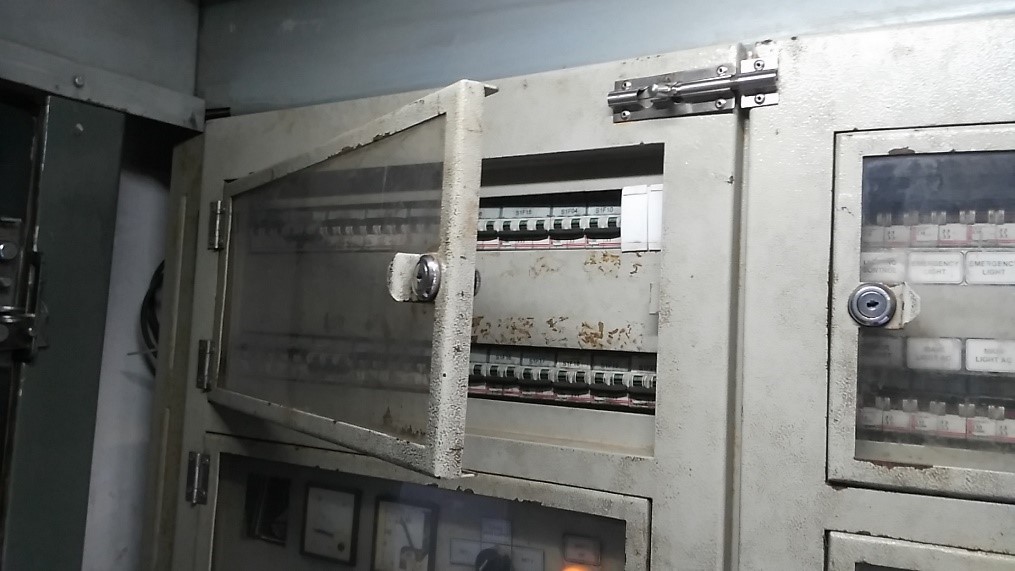
I remember a time during one of my early postings. I got so hassled inspecting the same problems again and again, that I resolved not to visit a depot unless I had addressed all the previous observations that had been made, or had made some progress worth reporting. However, the inspection quotas ensured that I was back inspecting the same depot again, noting down the same action points once again. The system so routinely inspects, that it forgets what it is inspecting! Please see the photograph of electrical panels below! The covers of electrical panels have been opening and hanging for over 3 decades now, and it is the same problem (may be varying in degree) whether it be general second, or Rajdhani/ Shatabdi! Railways is a very democratic organization. This problem is the attributed cause of serious fires in general second coaches, and a regular eye sore in higher class coaches. Only today I saw a video of an air plane crash being attributed to a knob being left in the wrong position after maintenance, losing over a 100 lives.

Railway Switch board.jpg

Have no inspecting officers noticed it in all their train journeys? If we can’t lock the covers and keep them in their place, let us not have them! They are already missing in 50% of the places, let them not be fitted in the first place.
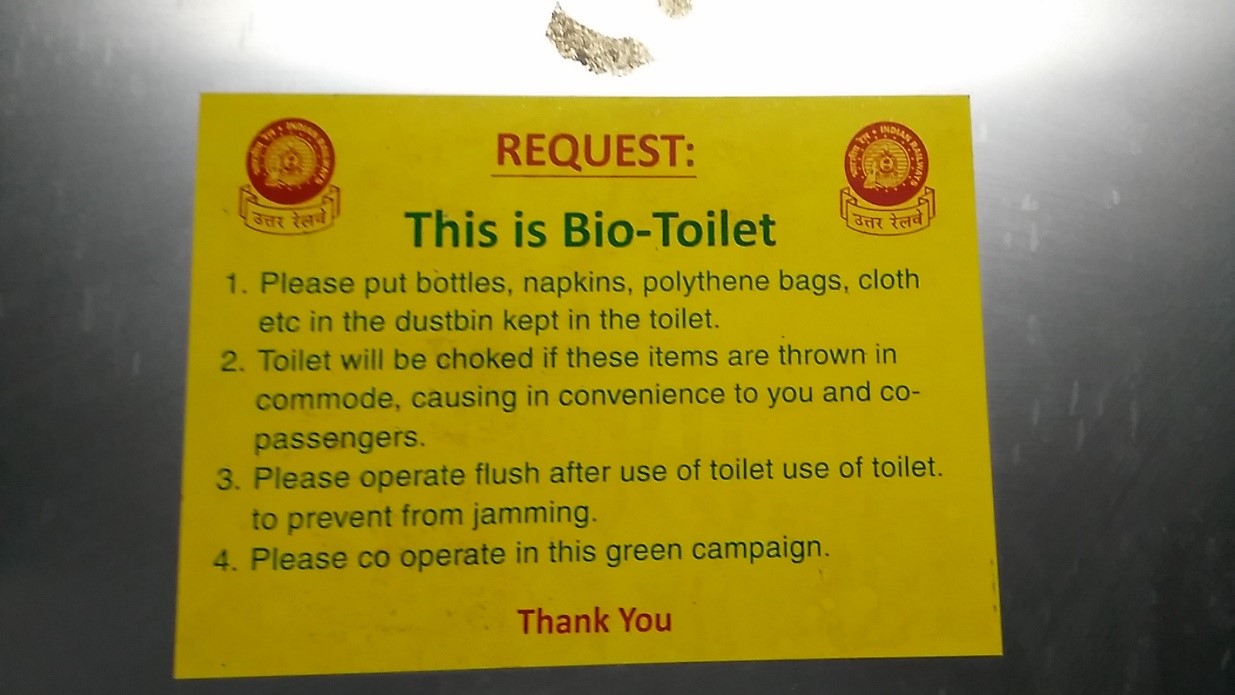
Another classic example is the innocuous notice below.

Railway Biotoilet notice

I have been training my pre-teens to keep themselves occupied in restaurants (while waiting for food) by looking for spelling mistakes in the menu card! It is an entertaining exercise, but with word having inherent spell check fewer and fewer mistakes are found. The notice above would have provided them with a gala time. It is a public notice that no one cared to proof read before printing! Further, while railways would have spent a significant amount of money printing them and pasting them, no one cared to ensure that they be pasted straight. Also noticed the half peeled seat numbering stickers—the once that were recently pasted with brail lettering! Is there one thing that we can do properly! May be yes! 5 years later I saw most door closures working, and having date of fitment over two years back. But someone would have to verify this if it is true.
However, these are tell-tale signs to the bigger problem. They have been addressed in the inspecting culture by having more inspections! But would that solve the issue! Would the door closure issue be fixed by the inspections? It got resolved (if it did) when the Railway Board changed specifications and ensured their quality! A job that according to me was not its responsibility.
Again, these are not isolated cases. How have the ills of collie overcharging, broken platform floors, broken lights, dirty linen, broken road surfaces at railway crossing escaped the attention of the regularly inspecting officials! Actually, they have not missed the attention of these officials, they have simply been ignored! We need more of the hands at work, rather than the eyes and ears inspecting finding faults and ignoring them.
And above all, it will definitely help if we can have some minds at work too!
Epilogue:
Opening the newspaper today and reading about a railway accident reconfirms the second point about inspections that I made above. Utkal Express derails near Khatauli, killing 30, when the site of accident is being inspected by a senior officer. Do not jump to conclusions, as circumstantial evidence and piecing together evidence is not enough. How can a senior civil engineer inspecting at a site under maintenance cause an accident? Pun intended! In my 23 years of railway experience, this was an ideal setup for one to find broken brake blocks, wagon parts, or even any other rolling stock component on track. And, suddenly there is an alternate story of how the train suddenly jumped because of a previous train’s component on track. I await one!

What do government officers do?

I have spent the last 5 days reading about the life experiences of Jagdish Khattar (An ex IAS, MD of Maruti Udyog 2000-2007), visited two government offices (NHAI and Railway Board) and a Visa processing center. Four very different government run organizations — with key differences lying in full/partial governmnet ownership, Indian/UK, policy/operational, service/manufacturing — but also similar. All of them existing to do essential public servcie jobs, and with their tasks being of regular and routine nature. What struck me was the deep entrenchment into routine working and it being THE JOB (NHAI and RB) as against outsourcing it or breaking it up (Maruti or UK VISA). People in NHAI and RB were busy with routines, and this has become their life and job.

This also reminds me of a remark in Mr. Ashwani Lohani’s ten year old book — “ Remaining busy is considered synonymous to deliverance. How busy an individual is has become an established norm for judging the operational efficiency of the person” Pg 6 Ch 1 and later what follows is a “A perpetual frown on the face that conveys the impression of carrying the trouble’s of the world on one’s head” Pg 7, ch 1. The Sarkari way of working!

I am uncomfortable with this, and the perpetuality of this routine working! The troubling questions — first and foremost– Is there anything wrong with this sarkari way of working! If not, we are fine and let us carryy on as is. If it worries us, the existing options lie in outsourcing (UK Visa) or in change in ownership (Maruti)! The second question – are these THE options or we can think of alternatives beyond them. The third question — How long will the bureaucracy take to think of the alternatives! Will the other stakeholders hold their patience for all this time? How long before they start exploring the existing available options.

The looming threat! Maruti negotiated when it found that the only option for it lay in replacing the routine manual material movements with conveyors and robots, quite in contrast with they had thought of 2 decades back. UK Visa office cut the work out from their embassy and handed it over to low paid Indians. We continue to tell our students — recognize that the nature of work is changing and is changing fast! When will the sarkar recognize the need to shed the routine working and hand it over to their own or external systems. Devote the highly intelligent resources that they possess to more value adding roles!