Now,I travel far less by train compared to what I have done during most of my railway life. These are some observation during one such train journey in August 2017, and written while on the train. Railways is a huge system, with a very capable set of people, but it has been delivering far less than what it is capable of. In this piece, I identify two reasons which could lie behind this.
The railway system fails to systematically learn from failures.
o The system is too busy hiding, defending, and negotiating failures, that there is little energy left for systematically learning from failures.
There are far too many ears and eyes inspecting, compared to the minds and hands at work.
Below I attempt to qualify each of these conjectures with some examples.
LEARNING FROM FAILURES
As I look outside the train window, I see multiple rakes of covered goods wagons roll by. These were the BCNA wagons that had given me many restless nights during my railway days. The conventional covered wagon had been redesigned in 1990’s to increase its loading capacity. This also led to its doors getting modified for easy loading and unloading. Launched and celebrated as a great innovation it soon emerged that during train running the doors would open out, and break signals and other fixed structures. This became an operational nightmare, with trains behaving as torpedos. After numerous attempts of hiding, defending, and negotiating, the failure was recognized and it was decided that the doors would be redesigned for new wagons, and also modified in existing wagons. Wagons were called back and refitted with modified doors. A huge failure, which would have cost railways crores of rupees.
Firstly, is there an estimate of what the mistake costed railways! While we do have guess estimates of what the challenger crash costed, or what the titanic sinking costed, but we have never cared to estimate the cost of this failure. If you don’t measure it, you are unlikely to address it. Secondly, mistakes happen, and when one attempts new ideas they happen more often. But, these mistakes are supposed to pave the steps to success. I wonder, what the railway management’s take away was from this failure, other than ensure that changes to proven design not be made. Thirdly, was this a one-off failure? We would never know! We never got it studied and never got it documented.
Sitting in one of the most modern coaches over the railway system, every ten minutes I am subjected to a longitudinal jerk. This jerk, a decade after the introduction of LHB coaches, is enough evidence that little learning has happened from failures! This problem is known to railway managers from the first time that they ran trials on LHB rakes, and it still exists a decade later! There are many more such failures – rail fractures, OHE snapping, etc. which I can name. And, many more of those which go unnamed in the railways failure investigation, getting attributed to law order or cow runover! For instance, buckling of track in extreme winter, to which we never even attempted to find solutions to!
It would not be out of place to argue that the significant improvements in railways overtime are largely technology driven, and not because of learnings from failures. Most of the things within the direct sphere of influence of railway managers have remained the same, with little visible improvements on their own (for instance poor quality in purchase). Even office cleanliness and efficiency in procurement had to be externally driven by the prime minister and technology respectively.
INSPECTING AND WORKING
I remember a time during one of my early postings. I got so hassled inspecting the same problems again and again, that I resolved not to visit a depot unless I had addressed all the previous observations that had been made, or had made some progress worth reporting. However, the inspection quotas ensured that I was back inspecting the same depot again, noting down the same action points once again. The system so routinely inspects, that it forgets what it is inspecting! Please see the photograph of electrical panels below! The covers of electrical panels have been opening and hanging for over 3 decades now, and it is the same problem (may be varying in degree) whether it be general second, or Rajdhani/ Shatabdi! Railways is a very democratic organization. This problem is the attributed cause of serious fires in general second coaches, and a regular eye sore in higher class coaches. Only today I saw a video of an air plane crash being attributed to a knob being left in the wrong position after maintenance, losing over a 100 lives.

Have no inspecting officers noticed it in all their train journeys? If we can’t lock the covers and keep them in their place, let us not have them! They are already missing in 50% of the places, let them not be fitted in the first place.
Another classic example is the innocuous notice below.
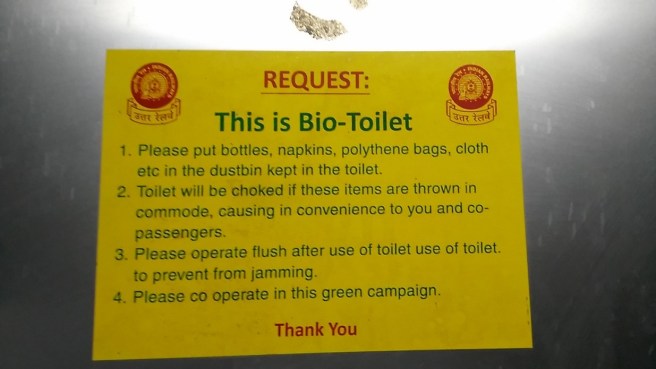
I have been training my pre-teens to keep themselves occupied in restaurants (while waiting for food) by looking for spelling mistakes in the menu card! It is an entertaining exercise, but with word having inherent spell check fewer and fewer mistakes are found. The notice above would have provided them with a gala time. It is a public notice that no one cared to proof read before printing! Further, while railways would have spent a significant amount of money printing them and pasting them, no one cared to ensure that they be pasted straight. Also noticed the half peeled seat numbering stickers—the once that were recently pasted with brail lettering! Is there one thing that we can do properly! May be yes! 5 years later I saw most door closures working, and having date of fitment over two years back. But someone would have to verify this if it is true.
However, these are tell-tale signs to the bigger problem. They have been addressed in the inspecting culture by having more inspections! But would that solve the issue! Would the door closure issue be fixed by the inspections? It got resolved (if it did) when the Railway Board changed specifications and ensured their quality! A job that according to me was not its responsibility.
Again, these are not isolated cases. How have the ills of collie overcharging, broken platform floors, broken lights, dirty linen, broken road surfaces at railway crossing escaped the attention of the regularly inspecting officials! Actually, they have not missed the attention of these officials, they have simply been ignored! We need more of the hands at work, rather than the eyes and ears inspecting finding faults and ignoring them.
And above all, it will definitely help if we can have some minds at work too!
Epilogue:
Opening the newspaper today and reading about a railway accident reconfirms the second point about inspections that I made above. Utkal Express derails near Khatauli, killing 30, when the site of accident is being inspected by a senior officer. Do not jump to conclusions, as circumstantial evidence and piecing together evidence is not enough. How can a senior civil engineer inspecting at a site under maintenance cause an accident? Pun intended! In my 23 years of railway experience, this was an ideal setup for one to find broken brake blocks, wagon parts, or even any other rolling stock component on track. And, suddenly there is an alternate story of how the train suddenly jumped because of a previous train’s component on track. I await one!

 Swapnil Garg's home on the WWW